Ask who pays for dinner in India and the honest answer depends on one question: who invited whom, and why? At a family meal, the eldest or the host usually reaches for the bill. On a birthday, the person celebrating often pays for everyone. Among college friends and young professionals in big cities, one person paying and everyone else sending their share by phone has become completely normal.
That mix tends to surprise visitors from the US and Canada, where splitting is the default and the birthday person almost never pays. It surprises Indian travelers too, when an even split in Japan or a cover charge in Italy feels oddly formal. Here is the verdict for each situation, plus phrases for asking for the bill, how tipping and service charges work, and a table comparing India with other countries.
One caution before the details: India is enormous and varied, with many languages, faiths, regions and income levels. The norms below are broad patterns, not rules every family follows. Use them as a starting point and take your cues from the people at your table.
Who Pays for Dinner in India: The Short Answer
Three ideas shape most bill decisions in India: hospitality, seniority and occasion. Once you understand how they interact, most situations become predictable.
- Hospitality. The Sanskrit phrase Atithi Devo Bhava, often translated as “the guest is god,” is a familiar expression of how seriously many Indians take hosting. If someone invites you, they generally expect to pay, and they may feel slightly hurt if you push too hard to take over.
- Seniority. Age and status matter. Parents, older relatives, the senior person at work or the oldest friend in the group often pay, and younger people are expected to offer but not necessarily to win.
- Occasion. Good news comes with a bill. Birthdays, promotions, a first salary, exam results or an engagement can all trigger the request for a “treat,” which means the person celebrating pays.
Where none of these apply, for example a casual dinner among peers with no host and nothing to celebrate, splitting is the norm, especially in large cities such as Mumbai, Delhi, Bengaluru, Hyderabad, Chennai, Pune and Kolkata. So the practical answer to who pays for dinner in India is: find the host, the elder or the celebrant first; if there isn’t one, split.
Who Pays by Situation
Family dinners
At family meals out, the senior earning member of the family, often a parent or an older uncle or aunt, traditionally pays. That is shifting in a warm way: adult children who have started working often make a point of paying for their parents, and some families treat a child’s first salary as the moment to take everyone out. Either way, expect a friendly tussle. Relatives may grab the bill folder, slip a card to the server early, or quietly settle at the counter on the way to the restroom.
If you are a guest at a family dinner out, offer clearly once or twice. If the host refuses firmly, thank them warmly and plan to return the favor, whether by hosting next time or bringing a thoughtful gift. Insisting again and again can feel like you are questioning their ability to host.
This dynamic will be familiar to anyone who has read about the fight for the bill at Chinese dinners: in both cultures, the offer itself is part of the courtesy, even when everyone knows who will end up paying.
Dinner with friends
Among friends of similar age with no special occasion, splitting is standard. The typical pattern is that one person pays the whole bill and everyone else transfers their share by phone afterward. Some groups split evenly; others go item by item when orders vary a lot. When only some people order alcohol, it is considerate for the drinkers to cover that part separately, since many people in India don’t drink for religious, family or personal reasons.
Long friendships often run on alternation instead of math: “You got the last one, I’ll get this one.” That works well as long as it genuinely balances out over time and nobody quietly ends up paying more.
Birthdays and “treats”
This is the biggest difference from North America. In the US and Canada, friends usually cover the birthday person’s meal. In much of India, the birthday person is the one who gets asked, “So where’s the treat?” and pays for the group, whether that means a full dinner or snacks and cake. The same goes for a new job, a promotion, a big exam result or an engagement.
Plenty of friend groups, especially mixed or internationally minded ones, now do it the other way or simply split, so if you are unsure, ask the organizer how this group handles it. Our guide to who pays for a birthday dinner covers the North American conventions and group scripts if you need to blend the two traditions.
First dates
On first dates, the traditional expectation in India, as in many places, has been that the man pays. In cities and on dating apps, younger daters increasingly treat it the way many North Americans do: the person who suggested the date often pays, splitting is perfectly acceptable, and alternating on later dates is common. Expectations vary by city, family background and the two individuals involved, so the safest approach is a sincere offer to split. If your date declines, accept with thanks and offer to cover dessert, coffee or the next outing.
If you are meeting someone new, the basics apply everywhere:
- Meet in a busy public place, such as a restaurant or café that is easy to reach.
- Tell a friend where you are going and who you are meeting.
- Arrange your own way there and back, whether that’s your own vehicle, a ride-hailing app or public transport.
- Leave if anything feels uncomfortable; you don’t owe anyone an explanation or the rest of the meal.
Work dinners
Work meals follow hierarchy. Team dinners and celebrations are often paid for by the company or by the most senior person present, and client dinners are paid for by the hosting company. If your manager picks up the bill, a simple, warm thank-you is the right response; fighting your boss for the check is unusual. A new employee or someone who just got promoted may also be expected to give a small treat to the team, often sweets or snacks rather than a full meal.
When you are invited to someone’s home
Never offer money for a home-cooked meal; it would come across as treating your host like a business. Instead, bring a small gift: a box of sweets from a good sweet shop, fruit, flowers or something from your home country. Be careful with alcohol, since many households don’t drink, and keep in mind that the household may be vegetarian. The way to “pay” is to reciprocate later by inviting them out or to your place.
How Splitting the Bill Works in India
Paying is usually easy. Sit-down restaurants in cities generally accept cards and cash, and phone payments through India’s UPI system, made by scanning a QR code, are extremely common, from street stalls to upscale dining rooms. That convenience shapes how groups split.
- One payer, many transfers. The most common method. One person pays the restaurant, then everyone sends their share through a payment app. Many popular Indian payment apps include a split or group feature for exactly this.
- Multiple cards. Some restaurants will divide the bill across several cards, but it is less routine than in the US or Canada and can be slow at busy places. If you want it, ask early, ideally when you order.
- Cash pooling. Still common in smaller towns, casual eateries and among students: everyone puts money in the middle and one person settles.
Even splits are popular because they avoid awkward arithmetic, but itemizing is fine when one person had a starter and a soft drink while others ordered several courses. The person who fronts the bill should share the total in the group chat promptly, and everyone else should pay back quickly; slow repayment is the fastest way to make splitting feel awkward. If you would rather cover more than your share, our scripts for offering to pay politely work just as well in India as at home.
Tipping, Service Charge and Taxes on Indian Bills
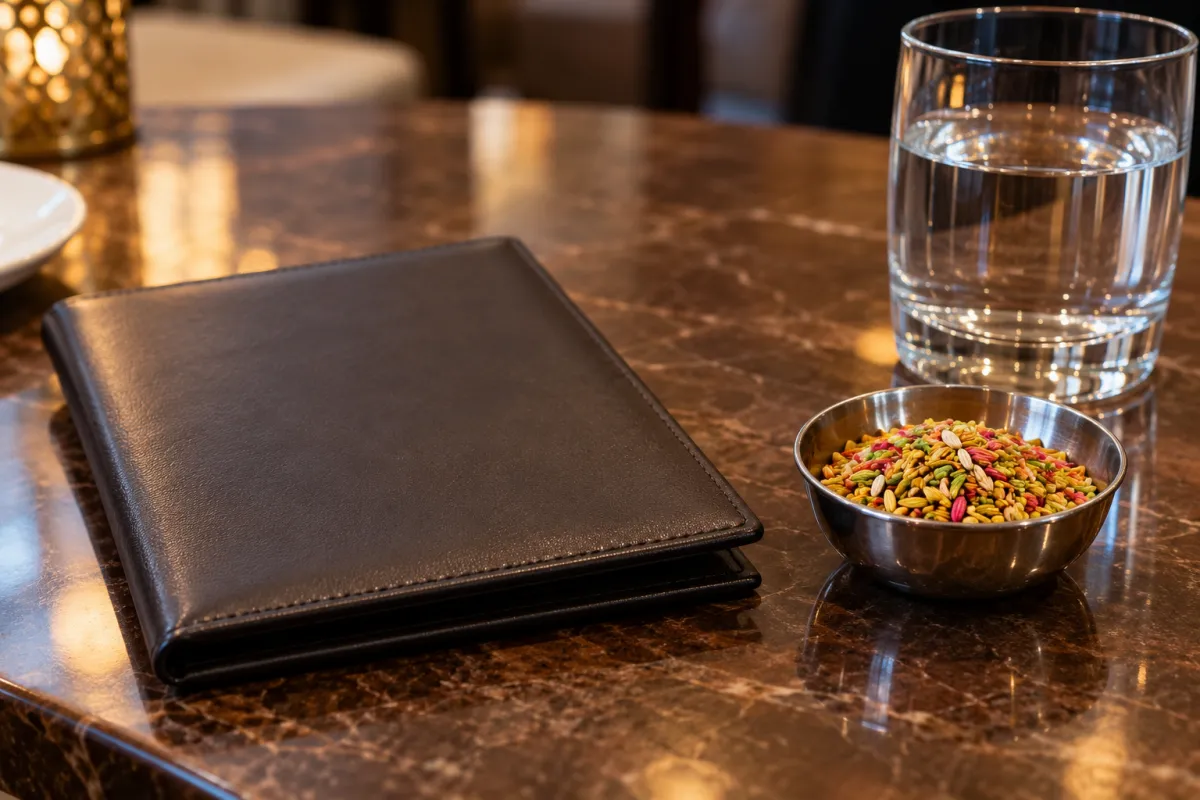
Read the bill before you add anything. An Indian restaurant bill typically lists the food and drinks, then taxes such as GST, and sometimes a separate service charge line.
- Taxes are added on top of menu prices at many restaurants, so the total can be higher than the menu suggested. This is normal and not something to dispute.
- Service charge has been a contested consumer issue in India, and official consumer-protection guidance has pushed restaurants to treat it as voluntary rather than compulsory. Because rules and court decisions on this have evolved, check current guidance from India’s consumer affairs authorities if it matters to you. In practice, if you see a service charge and would prefer to tip directly, you can politely ask for it to be removed.
- Tipping at sit-down restaurants is appreciated for good service when no service charge has been added. A modest tip, left in cash in the bill folder or added when paying, is typical. Tipping at street food stalls, counters and quick-service places is generally not expected.
For North American visitors, the key adjustment is mindset: tipping in India is generally treated as a thank-you rather than the firm expectation it is for table service in the US and Canada. You will not offend anyone by tipping, but you also don’t need to apply home-country habits automatically. Cash tips handed to or left for your server are a simple way to make sure the gesture reaches the person who looked after you.
Phrases to Ask for the Bill (and Offer to Pay)
English works in most city restaurants, and Hindi is widely understood across north and central India. In southern and eastern states, people may speak Tamil, Telugu, Kannada, Malayalam, Bengali or other languages day to day, and English is often a more natural choice than Hindi there. When unsure, polite English is always fine.
| Phrase | Language | Meaning | When to use it |
|---|---|---|---|
| Could we get the bill, please? | English | Standard request for the bill | Anywhere |
| Bill de dijiye. | Hindi | Please give us the bill | Polite request in Hindi-speaking areas |
| Bill le aaiye. | Hindi | Please bring the bill | Same, slightly more direct |
| Card chalega? UPI chalega? | Hindi / Hinglish | Do you take card? UPI? | Before ordering at small places |
| Split kar lete hain? | Hinglish | Shall we split it? | Friends, colleagues, dates |
| Main pay karta hoon. / Main pay karti hoon. | Hinglish | I’ll pay (male / female speaker) | Offering to cover the bill |
| Is baar meri taraf se. | Hindi | This time it’s on me | Treating someone |
| Agli baar aapki baari. | Hindi | Next time it’s your turn | Accepting someone’s treat graciously |
| Service charge included hai? | Hinglish | Is service charge included? | Checking the bill before tipping |
A friendly tip: in many restaurants, catching the server’s eye and miming a signature in the air is understood as a request for the bill. At sit-down places, servers usually wait for you to ask rather than bringing the bill unprompted, so a slow bill is rarely a sign you are being ignored.
How India Compares: Who Pays Around the World
If you travel, host visitors or have friends from several cultures, it helps to see who pays for dinner in India side by side with other places. The table below summarizes broad tendencies.
| Country | Who usually pays | Splitting norm | Tipping / service |
|---|---|---|---|
| India | Host, elder or the person celebrating; often the inviter on dates | One person pays, others transfer by phone; even splits common among friends | Tip appreciated if no service charge; check the bill for a service charge line |
| United States | Inviter on dates; groups often split | Separate checks and card splits are routine | Tipping customary and expected for table service, on top of sales tax |
| Canada | Similar to the US | Splitting by card at the table is routine | Tipping customary for table service; taxes added at the end |
| Italy | Inviter; on dates the man often offers, though splitting is growing | Alla romana: equal shares among friends | Coperto (cover charge) common; tipping modest and optional |
| Japan | Senior or host at work events; friends split | Warikan: split evenly or by order | No tipping; usually pay at the register |
| South Korea | Elder or senior often pays; someone else may take the next round | Splitting more common among younger friends | No tipping tradition |
| China | Host pays; friendly fight for the bill | Splitting more common among younger people | Tipping not customary in most restaurants |
| United Kingdom | Varies; splitting common | Splitting by card is common | Discretionary service charge often on the bill; check before tipping |
| Germany | Often each person pays their own | Server asks “zusammen oder getrennt?” (together or separate) | Round up or add a small tip, told to the server when paying |
These are broad tendencies to help you prepare, not rules; individual families, cities and friend groups vary.
Who pays on a date in Italy
If you’re wondering who pays on a date in Italy, the traditional answer resembles India’s: the man or the person who asked usually offers, and a gracious offer is expected. Among younger Italians, splitting is increasingly common, and friends usually divide the bill equally, which Italians call paying alla romana. Two other details matter: many Italian restaurants add a per-person coperto (cover charge), and tipping is modest and optional, which feels closer to India than to the US.
Japanese bill splitting: warikan
Japanese bill splitting, known as warikan, is close to the opposite of India’s host-pays instinct. Among friends and colleagues of similar rank, dividing the total is normal and nobody fights for the check, though seniors often pay more or cover juniors at work events. There is no tipping, and you typically pay at the register near the exit rather than at the table. Our guide on whether you need cash in Japan walks through paying at the register and where cash is still needed.
The closest cousin: South Korea
Of the countries in the table, South Korea shares India’s emphasis on seniority most clearly: the elder or senior often pays, and someone else may cover the next round. If you have Korean friends or colleagues or plan to visit, our guide to tipping in Korea explains why tipping isn’t expected there and how to say thanks instead.
Ready-to-Use Scripts
When an Indian host insists on paying
“Thank you so much, that’s really generous of you. Next time is on me, and I mean it.” Then follow through by inviting them out or hosting at home.
When you want to pay as the guest
Offer early and discreetly, not when the folder lands on the table: “I’d love to take care of this one; you looked after me last time.” If the host clearly invited you as their guest, let them pay and reciprocate later instead of slipping your card to the server.
On a first date
“I’ve had a really good time. Shall we split this?” If your date insists on paying: “That’s kind of you, thank you. Coffee next time is on me.”
When a birthday is coming up
To the organizer: “How does this group usually do birthdays, treat or split? I’m happy either way.” If you are the one being asked for a treat and a big dinner isn’t in your budget: “I’m in for a treat! Let’s do chai and snacks, and the fancy dinner can wait for the promotion.”
When you are fronting the bill for friends
“I’ll pay the restaurant, and everyone can send me their share. I’ll post the total in the group chat before we leave.”
When there is a service charge you’d rather replace with a tip
With a smile: “Could you remove the service charge, please? I’d prefer to leave the tip myself.”
Whatever the situation, the spirit behind who pays for dinner in India is generosity balanced over time. Offer sincerely, accept gracefully, and make sure the favor comes back around.
Want to turn this into an actual plan? MeetNow is a free app for meeting people in person: a host posts a plan at a public place, says who pays (host pays, split, pay your own or free) and picks who joins. It is live on the web and works in your browser, starting in Malta. The Android app is on Google Play; the iPhone app is not in the App Store yet. Open MeetNow and see the plans posted in Malta.
FAQ
Is it rude to split the bill in India?
No. Among friends, colleagues of similar level and couples in cities, splitting is normal, usually with one person paying and the others transferring their share by phone. It can feel awkward only when there is a clear host, an elder at the table or someone celebrating, because those people are traditionally expected to pay.
Who pays on a first date in India?
Traditionally the man paid, and many people still expect the person who asked to pay. Younger daters in cities increasingly split or alternate. The safest move is a sincere offer to split; if your date declines, thank them and offer to cover the next coffee or outing.
Do you have to tip at restaurants in India?
Tipping is not mandatory, but a modest tip is appreciated at sit-down restaurants when no service charge has been added. Check the bill first for a service charge line. Tipping at street food stalls, counters and quick-service places is generally not expected.
What does “give a treat” mean in India?
It means the person with something to celebrate pays for their friends or colleagues. Birthdays, a new job, a promotion, exam results or an engagement often come with the friendly question “Where’s the treat?” A treat can be a full dinner or just snacks, sweets and tea.
Should I offer to pay when an Indian host invites me to dinner?
At a restaurant, offer sincerely once or twice, then accept graciously if the host refuses and return the favor later. At someone’s home, never offer money; bring a small gift such as sweets, fruit or flowers, and invite them in return.