The short answer
The pagar a medias meaning is simple: pay half each. Pagar a medias (pah-GAR ah MEH-dyahs) means splitting a cost down the middle, usually between two people, like saying “let’s go halves” or “fifty-fifty” in English. The Real Academia Española’s dictionary defines the expression a medias as “por mitad”, by halves. It is not quite the same as going Dutch: for “everyone pays for their own order”, Spanish speakers more often say a la americana or cada quien paga lo suyo, and for an even group split in Spain, a escote. Last checked November 2026.
Pagar a medias meaning, word by word
Pagar is “to pay”. Medias is the plural feminine of medio, “half”. The fixed expression a medias works like an adverb meaning “by halves” or “half and half”, and the RAE’s Diccionario de la lengua española lists it under medio with the sense “por mitad”. Put together, pagar a medias means “to pay by halves”.
You’ll hear it in a few common forms:
- ¿Pagamos a medias? Shall we split it half and half?
- Vamos a medias. We’re going halves (on this purchase, this taxi, this gift).
- Lo pagamos a medias. We paid for it fifty-fifty.
- Compramos el coche a medias. We bought the car together, half each.
Because it means halves, a medias fits most naturally with two people: a couple, two friends, two roommates. With a bigger group, people still say it loosely, but the more precise phrases below are more common.
A medias vs a escote vs a la americana
English speakers tend to throw all of these together as “splitting the bill”. In Spanish they describe different methods, and picking the right one avoids confusion at the table.
| Expression | What it means | Typical use | Closest English |
|---|---|---|---|
| Pagar a medias | Each of two people pays half | Couples, two friends, shared purchases | Go halves, fifty-fifty |
| Pagar a escote | Each person pays an equal share of a common cost | Groups in Spain | Split evenly |
| Pagar a la americana | Each person pays for what they consumed | Spain, colloquial | Go Dutch, separate checks |
| Cada quien paga lo suyo / cada uno paga lo suyo | Everyone pays their own | Latin America (cada quien) and Spain (cada uno) | Pay your own |
| Dividir la cuenta / dividir entre todos | Divide the bill | Neutral, understood everywhere | Split the bill |
| Hacer una vaca / una vaquita | Pool money into a kitty for a shared cost | Many Latin American countries | Chip in, a kitty |
| Poner un bote | Everyone puts money into a common pot | Spain, nights out with rounds | A kitty |
The RAE defines escote as the share that corresponds to each person of an expense made in common by several people, which is why a escote is the go-to phrase for an even group split in Spain. In much of Latin America, a vaca in its money sense is the sum several people pool together, often to cover a shared expense.
Notice the trap: in English, “going Dutch” usually means paying your own, but some people use it for an even split. Our guide to asking for the bill in different languages has “can we pay separately?” in 20 languages, and the Italian cousin of a escote is explained in alla romana meaning, with the phrases for the check itself in asking for the bill in Italy.

How the phrases change from Spain to Latin America
Spanish is spoken in more than twenty countries, and bill-splitting vocabulary varies. These are common patterns, not hard rules, and people in big cities often mix them.
- Spain. A medias for two people, a escote for an even group split, a la americana or cada uno lo suyo for paying your own. On nights out with rounds, friends may poner un bote, a common pot. You’ll also hear ¿Nos traes la cuenta? to ask for the bill. For how this plays out at the table, see our guide to paying the bill in Spain.
- Mexico and Central America. A medias is understood everywhere. Cada quien paga lo suyo or simply cada quien is very common for paying your own, and groups may hacer una vaquita for a shared gift or bottle.
- Colombia, Venezuela and the Andes. Hacer una vaca is a well-known way to pool money. Dividir la cuenta and a medias both work at restaurants.
- Argentina, Uruguay and Chile. A medias and dividir are common, along with pagar cada uno lo suyo. Date dynamics differ, as our piece on who pays on a date in Argentina explains.
- Spanish-speaking communities in the US and Canada. All of the above, often mixed with English: “¿la dividimos?” or “¿pagamos split?” are not unusual in bilingual groups.
Example sentences you can use
| Spanish | English | When to use it |
|---|---|---|
| ¿Pagamos a medias? | Shall we go halves? | With one other person, before the bill arrives |
| Vamos a medias con el taxi. | Let’s split the taxi half and half. | Sharing a ride |
| ¿Lo pagamos a escote? | Shall we split it evenly? | A group in Spain |
| Cada quien paga lo suyo, ¿va? | Everyone pays their own, okay? | A group in Mexico or Central America |
| ¿Podemos pagar por separado? | Can we pay separately? | Asking the server |
| ¿Nos divide la cuenta, por favor? | Could you split the bill for us, please? | Asking the server to divide it |
| Hagamos una vaquita para el pastel. | Let’s chip in for the cake. | Pooling money for a shared item |
| Esta vez pago yo, la próxima tú. | I’ll get this one, you get the next. | Taking turns |
A tip on tone: proposing a medias is neutral and practical, never stingy. If you want to suggest it gracefully, do it when you sit down or when you order, not as the server walks up with the card machine.

Mistakes English speakers make with these phrases
- Using a medias for a big group. It is understood, but “a escote” in Spain or “dividir entre todos” elsewhere is more precise when six people share a bill.
- Translating going Dutch literally. There is no common Spanish phrase about the Dutch; say “cada uno paga lo suyo” or “a la americana” instead.
- Proposing a split after someone said te invito. Thank them and offer to get the next one instead.
- Waiting for the bill to arrive. In Spain the check usually only comes when you ask for it, so say “la cuenta, por favor” when you are ready.
- Arguing at the table. Settle the method when you order, not when the server is standing there with the card machine.
The phrase that cancels all of them: te invito
All the splitting phrases have one important exception. In Spanish, te invito (“I’m inviting you”) or invito yo usually means “it’s on me”. When someone says it, they’re offering to pay, and answering with “¿pagamos a medias?” can sound like you’re refusing a gift. A warm “¡Gracias! La próxima invito yo” (thanks, next time it’s on me) is the graceful response.
This matters most on dates. In Spain, splitting is common among younger people, but the person who says te invito is expected to pay. Our guide to who pays on a first date in Spain goes deeper on how to read that signal.
The other meaning: hacer algo a medias
Outside money, a medias also means “halfway” or “not completely”. Un trabajo a medias is a half-finished job, and decir la verdad a medias is telling a half-truth. So “lo hizo a medias” usually means “he did it halfway”, not “he paid half”. Context almost always makes it clear: if pagar, la cuenta or a price is in the sentence, it’s about splitting.
Whatever language you use, the easiest split is the one agreed before anyone orders. Want to turn this into an actual plan? MeetNow is a free app for meeting people in person: a host posts a plan at a public place, says who pays (host pays, split, pay your own or free) and picks who joins. It is live on the web and works in your browser, starting in Malta: open MeetNow and see the plans posted in Malta.
Frequently asked questions (FAQ)
What does pagar a medias mean in English?
It means to pay half each, or to split a cost down the middle. Between two people it is the Spanish equivalent of saying “let’s go halves” or “fifty-fifty”.
Is pagar a medias the same as going Dutch?
Not exactly. Going Dutch usually means each person pays for what they ordered, while a medias means splitting the total in half. In Spanish, paying for your own order is closer to “a la americana” or “cada quien paga lo suyo”.
What is the difference between a medias and a escote?
A medias is splitting into halves, typically between two people. A escote means each person in a group pays an equal share of a common expense, however many people there are.
How do you say split the bill in Spanish?
Common options are “¿Pagamos a medias?” for two people, “¿Lo pagamos a escote?” in Spain for an even group split, “¿Dividimos la cuenta?” almost anywhere, and “cada quien paga lo suyo” when everyone pays for their own order.
Is it rude to suggest paying a medias on a date?
No. Splitting is common among younger people in Spain and many Latin American cities. Be aware that if someone says “te invito”, they are offering to pay, and insisting on splitting can come across as refusing a gift.
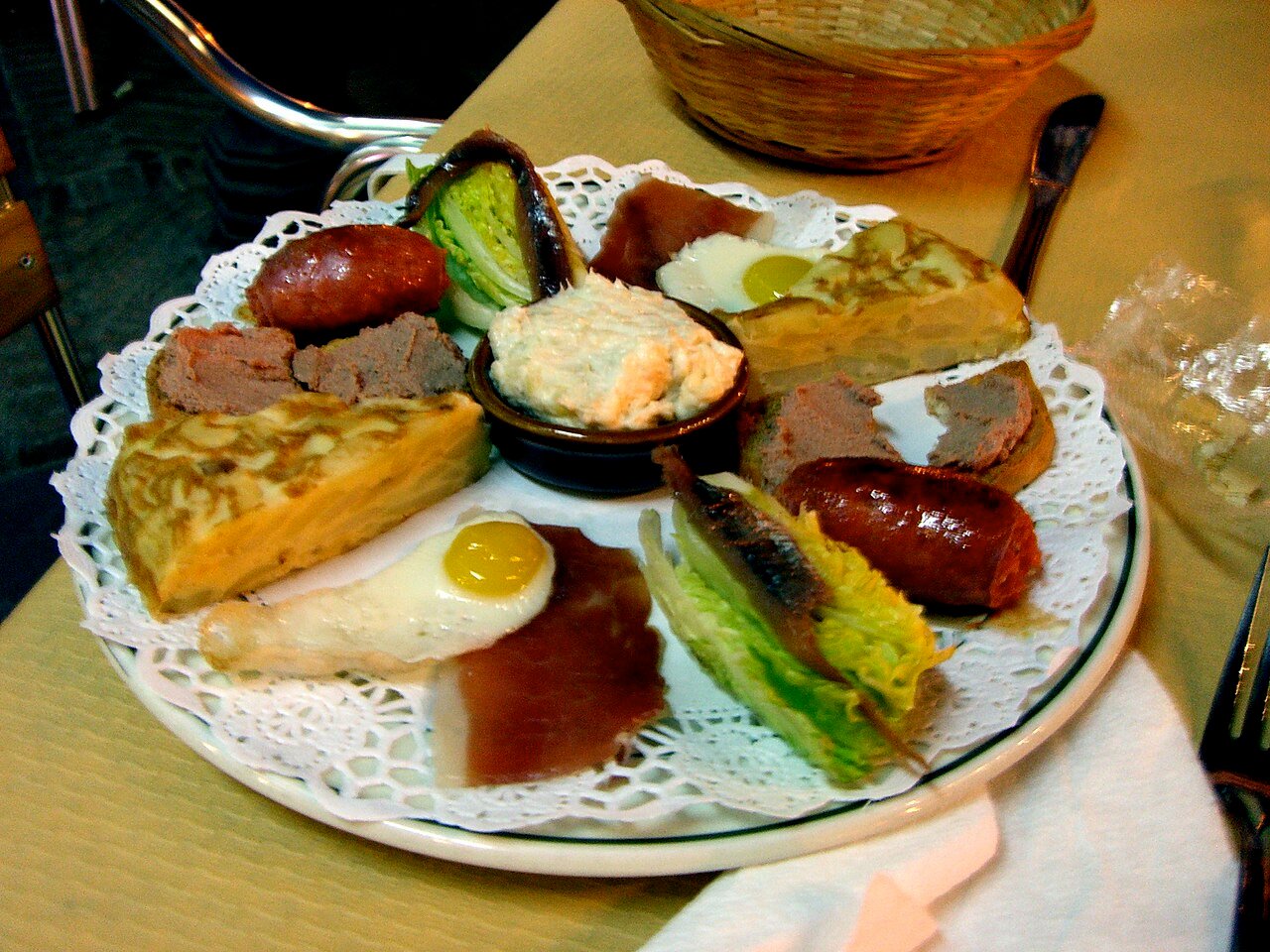
Featured photo: a plate of mixed tapas in a restaurant in Ronda, Andalusia, by Ben Coombs, CC BY-SA 2.0, via Wikimedia Commons.