The short answer
Portuguese dining etiquette is relaxed, generous and unhurried, with one money rule every visitor should know: the couvert. The bread, olives, butter and cheese that arrive before you order are not free, but you only pay for what you eat; send back what you don’t want before touching it. Beyond that, the bill comes when you ask (“A conta, por favor”), friends often split evenly or take turns treating, the person who invites usually pays, and tipping is modest and optional. Meals are long, and nobody will rush you.
Below: the couvert explained, how the bill works, who pays among friends and family, splitting, café and pastelaria habits, a comparison with Spain and Italy, phrases and FAQ. Last checked October 2026.
Portuguese dining etiquette rule one: the couvert
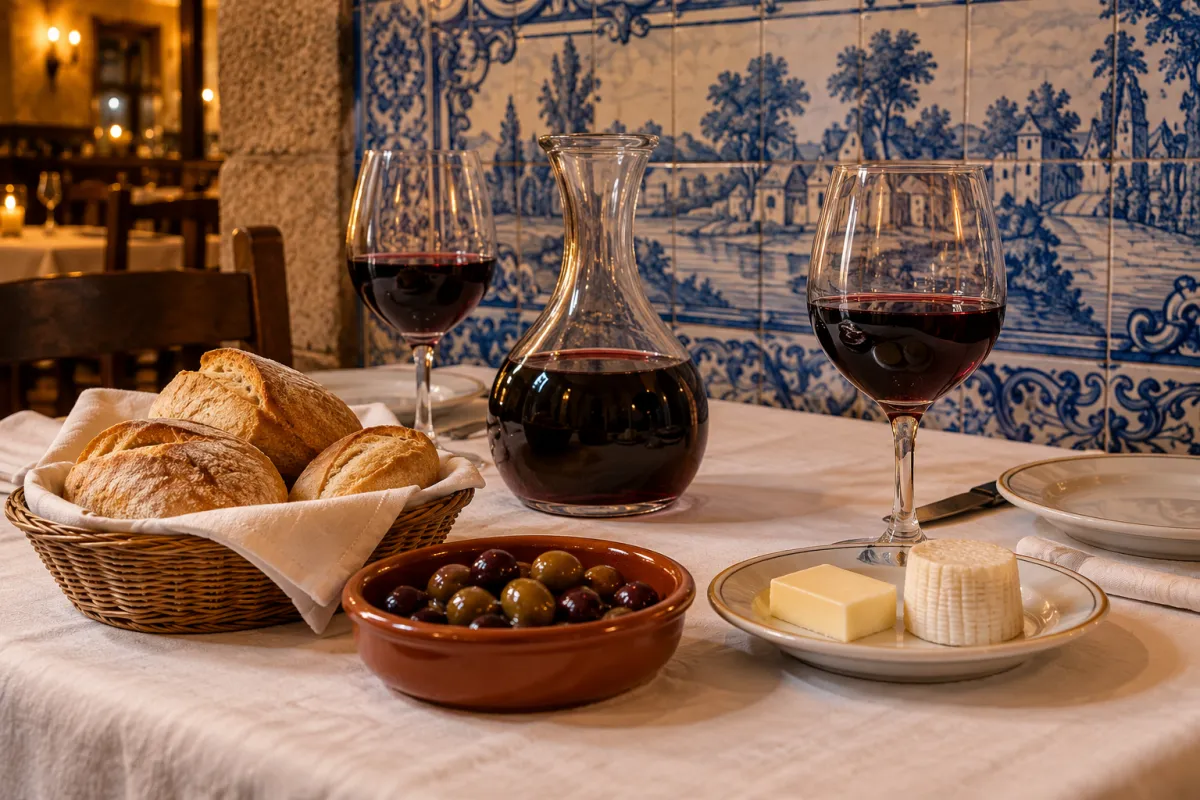
Sit down at many Portuguese restaurants and, before you’ve seen the menu, a basket of bread appears, perhaps with olives, butter, a small cheese, sardine pâté or carrots in vinaigrette. This is the couvert, and it’s the single most misunderstood thing on a Portuguese bill.
- It isn’t free. Each item has a price, usually shown on the menu.
- It isn’t compulsory. Portuguese consumer rules say no food or drink, couvert included, can be charged unless the customer ordered it or consumed it. Consumer site Portal da Queixa’s guide to the couvert rules explains the catch: if you eat it, you pay for it.
- You can pick and choose. Keep the bread, send back the cheese. You pay for what you eat.
- It’s not a tip. The couvert goes to the restaurant as part of the bill.
The polite way to decline is simple and common: “Não, obrigado/obrigada” with a small wave as the server sets it down, or “Pode levar, por favor” (You can take it, please). Nobody is offended. If you’re comparing with Italy’s fixed per-person cover charge, our guide to the coperto in Italy explains the difference.

Asking for and paying the bill
As in much of Southern Europe, the bill in Portugal doesn’t come until you ask. Lingering after the meal over coffee and conversation is normal, and bringing the check unprompted could feel like a hint to leave.
- Ask: “A conta, por favor.” A small writing gesture in the air also works.
- Check the bill: look for the couvert items you ate, drinks, and any service line.
- Pay: cards are widely accepted; the server often brings a card terminal to the table. Small cafés and tascas may prefer cash for very small amounts.
- Tip lightly if you wish: small change at casual places, about 5–10% for a really good dinner. Our tipping in Portugal guide has amounts by setting.
You may also be asked whether you want your tax number on the receipt (“Contribuinte?” or “Número de contribuinte?”). Residents use it for tax purposes; as a visitor you can simply say “Não, obrigado.”
Who pays: inviting, treating and splitting
Portuguese meals are social, and the money side tends to be easygoing. Common patterns:
| Situation | Who usually pays | Notes |
|---|---|---|
| Someone invites you (“Eu pago” / “É por minha conta”) | The inviter | Offer once; if declined, thank them and treat next time |
| Friends out for dinner | Even split or each pays their own | Decide early if you want separate payments |
| Coffee with a friend | Often one person pays both, and the other gets the next one | Small amounts make turn-taking natural |
| Family meal at a restaurant | Often the eldest or the inviter | Younger relatives may offer; accepting a refusal gracefully matters |
| Celebration (birthday, new job) | Often the person celebrating treats, or friends cover them | Varies by group; ask |
| Work lunch | The inviting company or the senior person | Follow the host’s lead |
These are common practice, not rules, and they vary by region, generation and friend group. The underlying principle matches our guide on whether whoever invites pays.
Splitting the bill
Among friends, an even split is common, especially when dishes were shared. You’ll hear “Vamos dividir?” (Shall we split?). Paying separately is fine too (“Podemos pagar separadamente?”), but it’s easier to mention it when ordering. If one person had far less, it’s normal for them to pay their own. Worked even vs itemized examples are in our guide to how to split the bill fairly, and our guide to asking for the bill in different languages has the phrase for paying separately in other countries.
Worked example: dinner for four in Lisbon
Illustrative prices, not a real restaurant. Four friends share starters and two platters; one doesn’t drink.
| Item | Amount |
|---|---|
| Couvert they kept (bread and olives; cheese sent back) | €6.00 |
| Two shared starters | €16.00 |
| Two platters (one dose each, shared by two) | €48.00 |
| Bottle of wine (three drinkers) | €18.00 |
| Water and a soft drink | €5.00 |
| Four coffees | €4.00 |
| Total | €97.00 (about $112) |
- Even split: €97 ÷ 4 = €24.25 each.
- Fairer for the non-drinker: the wine €18 ÷ 3 = €6 per drinker; everything else €79 ÷ 4 = €19.75. Drinkers pay €25.75, the non-drinker €19.75.
- Tip once: round the table up to €100–105.
Note what sending back the cheese saved: nothing wasted, nothing to argue about later. If the group had kept the whole couvert, the cleanest approach would be the same as for the starters: split it among everyone who ate from it, and agree on that before the bill arrives rather than item by item at the end.
Eating out with Portuguese friends or colleagues
If you are invited out by Portuguese friends, colleagues or a host family, a few things help:
- Let the host order the couvert and the wine if they want to; follow their lead.
- Expect a genuine offer to pay. Visitors are often treated; accept warmly and offer to return the invitation.
- Keep the pace. Don’t ask for the bill before the host does.
- Coffee is the signal. When coffees arrive, the meal is winding down; that’s a natural moment to offer to contribute.
- Return the favor in kind: pay for the coffees, a round, or invite them next time.
The rhythm of a Portuguese meal
- Lunch matters. Many restaurants offer a prato do dia (dish of the day) at lunch, often good value; it’s a great way to eat well on a budget.
- Dinner starts later than in the US, and lingering is normal.
- Coffee ends the meal. A short espresso, called a bica in Lisbon and a cimbalino in Porto, is the classic finish.
- Sharing is common. Petiscos (small plates) and big platters of fish or seafood are made for the table.
- Half portions (meia dose) are offered at many traditional restaurants; one dose is often enough for two.

Cafés and pastelarias
The café is the center of daily life in Portugal, and its customs are worth knowing:
- Standing at the counter for a coffee and a pastry is normal and often cheaper than table service.
- Pay at the end. In many cafés you order, eat and then pay at the counter or register on your way out.
- Treating is easy. “Eu pago os cafés” (I’ll get the coffees) is a small, very common gesture between friends and colleagues.
- Tipping: leave small change or nothing; nobody expects more.

Portugal vs Spain, Italy and the US
| Country | Who usually pays | Splitting norm | Tipping / service |
|---|---|---|---|
| Portugal | Inviter, or take turns | Even split or pay your own | Optional; couvert only if eaten |
| Spain | Inviter (“te invito”), or take turns | Even split (a escote); rounds in bars | Optional; small change to about 5–10% |
| Italy | Inviter, or split | Even split (alla romana) | Optional; coperto often listed |
| US and Canada | Inviter, or split | Separate checks common | 15–20% expected |
For Spain’s vocabulary of splitting, see our guide to paying the bill in Spain.
Dietary needs and ordering
Traditional Portuguese menus lean heavily on fish, seafood and meat, and vegetables often arrive as sides. If you have dietary needs, say so when you order rather than at the end: “Sou vegetariano/vegetariana” (I’m vegetarian) or “Tenho alergia a…” (I’m allergic to…). Servers in traditional places are usually happy to suggest a dish or a combination of sides. If you’re sharing platters with friends and you can’t eat most of them, it’s fair to pay for what you ordered rather than an even share; say it when ordering, not when the bill comes.
Table manners worth knowing
- Greet staff when you arrive: “Bom dia” until lunch, “Boa tarde” in the afternoon, “Boa noite” in the evening.
- Wait to be seated in sit-down restaurants; in casual places you can usually take a free table.
- Bread is for the meal, and it’s fine to use it to mop up sauce in casual settings.
- Don’t rush the server. A relaxed pace is part of the experience.
- Say thank you on the way out: “Obrigado” (men) or “Obrigada” (women).
Phrases for Portuguese restaurants
| English | Portuguese |
|---|---|
| The bill, please | A conta, por favor |
| No thanks, you can take it (the couvert) | Não, obrigado. Pode levar, por favor |
| I’m paying / It’s on me | Eu pago / É por minha conta |
| Shall we split? | Vamos dividir? |
| Can we pay separately? | Podemos pagar separadamente? |
| Can I pay by card? | Posso pagar com cartão? |
| Half portion, please | Meia dose, por favor |
| Keep the change | Pode ficar com o troco |
Common mistakes visitors make
- Eating the couvert, then disputing it. Decide before you start.
- Waiting for the bill. Ask for it.
- Ordering a full portion each when a meia dose or one dose to share would do.
- Insisting on paying after someone said “eu pago.” Thank them and get the next one.
- Tipping US-style. Far above local practice.
Sharing a table with new people
Portuguese meals are made for company, and the easiest tables are the ones where everyone knows how the bill works before the bread arrives.
Want to turn this into an actual plan? MeetNow is a free app for meeting people in person: a host posts a plan at a public place, says who pays (host pays, split, pay your own or free) and picks who joins. It is live on the web and works in your browser, starting in Malta. The Android app is on Google Play; the iPhone app is not in the App Store yet. Open MeetNow and see the plans posted in Malta.
FAQ: Portuguese dining etiquette
Do you have to pay for bread and olives in Portugal?
Only if you eat them or ordered them. The couvert (bread, olives, butter, cheese) brought to the table can be charged only if consumed. If you don’t want it, ask the server to take it away before you touch it.
How do you ask for the bill in Portugal?
Say “A conta, por favor.” The bill usually doesn’t come until you ask, because lingering at the table is normal.
Is it normal to split the bill in Portugal?
Yes. Among friends, an even split or each paying their own is common, and taking turns treating is common too. Mention separate payments early if you need them.
Who pays when you are invited out in Portugal?
Usually the person who invited. Offer once to contribute; if they decline, thank them and offer to treat next time.
Do you tip in Portugal?
Tipping is optional and modest: small change at cafés, rounding up at casual meals and about 5–10% for a very good dinner.
The bottom line
Portuguese dining etiquette rewards a relaxed pace: decide on the couvert before you touch it, ask for the bill when you’re ready, let the inviter treat (and return the favor), split evenly with friends, treat to coffees, and tip lightly. Bom apetite.