The short answer
Paying the bill in Spain works like this: you ask for it (“La cuenta, por favor”), nobody rushes you, and friends usually either split the total evenly (a escote) or take turns treating. If someone says “te invito,” they are paying for you. In tapas bars you often run a tab and pay at the bar on your way out. Tipping is light and optional; our separate guide covers it. The main surprise for North Americans is the rhythm: the meal is long, the bill comes only when asked, and splitting is relaxed and quick.
Below: the vocabulary of Spanish bill-paying (te invito, a medias, a escote, rondas, el bote), a comparison table with other countries, phrases you’ll use, and how to handle a group bill like a local. Last checked October 2026.
Paying the bill in Spain: asking for la cuenta
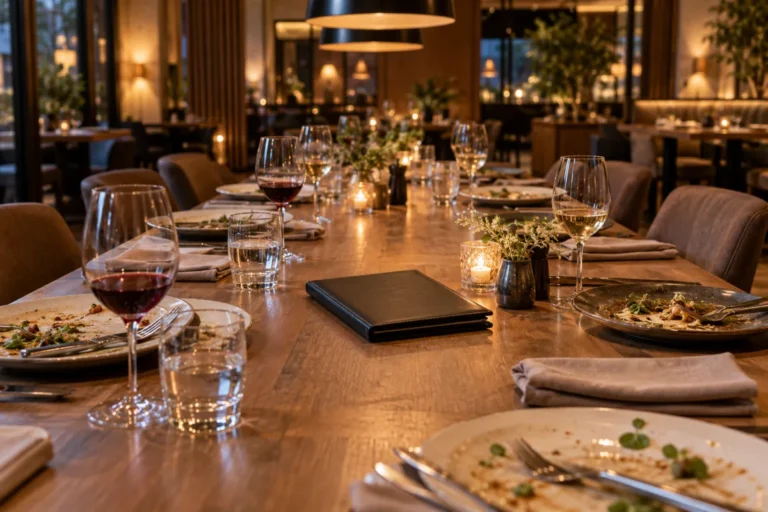
In most Spanish restaurants and bars, the bill does not arrive until you ask. Long meals and the sobremesa (lingering at the table after eating) are part of the culture, and bringing the check unprompted can feel like a hint to leave. So when you’re ready:
- Catch the server’s eye and say “La cuenta, por favor” (The bill, please).
- In casual bars, you’ll often hear “¿Me cobras?” or “¿Nos cobras?” (Can you charge me / us?). It’s informal and perfectly polite.
- A small writing gesture in the air is understood almost everywhere.
- Pay at the table or at the bar. In restaurants the server usually brings a card terminal; in bars you often go up to the counter.
Cards are widely accepted, and paying by card is normal even for small amounts in most places, though carrying a little cash is useful for small bars and for tips.
Who pays: “te invito” and taking turns
The most important phrase in Spanish bill etiquette is “te invito” (literally “I invite you”). Said at a bar or restaurant, it means “I’m paying for you.” The plural, “os invito” in Spain, covers a group. If someone says it, they are treating you, and the gracious reply is a thank-you and an offer to get the next one: “¡Gracias! La próxima la pago yo” (Thanks! I’ll get the next one).
Some common patterns:
| Situation | Who usually pays | Notes |
|---|---|---|
| Someone says “te invito” | They pay | Offer to get the next one |
| Friends out for tapas or dinner | Split evenly, or take turns | Split is quick and normal |
| A celebration (birthday, new job) | Often the person celebrating treats | Varies by group; ask if unsure |
| Rounds of drinks in a bar | People take turns buying a round | Keep track informally; buy yours before leaving |
| A first date | Varies; offering to split is common | “¿A medias?” is a light way to ask |
| Family meal at a restaurant | Often the eldest or the inviter | Others offer; accept gracefully if declined |
These are common practice, not rules, and they vary between regions, generations and friend groups. The underlying idea matches the classic etiquette rule that whoever invites usually pays.

Splitting the bill: a medias and a escote
Spanish has two everyday expressions for splitting:
- A medias (in halves): two people split the bill 50/50. “¿Pagamos a medias?” (Shall we go halves?)
- A escote: each person pays their share of a common expense. The Real Academia Española’s student dictionary defines “a escote” as each person paying the part that corresponds to them in a shared cost, and gives a nicely practical example: “¿Vamos a escote o paga cada uno lo que ha consumido?” (Shall we split it equally, or does everyone pay for what they had?)
That example sentence captures the real choice at a Spanish table: an even split of the shared total, or paying for what you consumed. With shared tapas and raciones (larger plates for the table), the even split is the natural default, because nobody can say who ate which croqueta.
The same habit exists in Italy as pagare alla romana (see our explainer on what alla romana means) and in English as going Dutch, though the details differ. For the equivalent phrases in other countries, see our guide to asking for the bill in different languages.
Separate bills
Asking for completely separate bills is possible but less common in Spain than in the US, especially in busy bars. If you need it, ask early: “¿Podemos pagar por separado?” (Can we pay separately?) Many groups instead have one person pay and the others send their share by cash or a payment app. If one person in the group had much less (a salad and water while others shared bottles of wine), it is fair and normal for them to suggest paying only their part; just say it kindly and early, before the bill arrives.
For worked examples of even vs itemized splits, see how to split the bill fairly.
Rounds, the bote and paying in tapas bars
Rondas (rounds)
In bars, friends commonly take turns paying for a round of drinks (una ronda) for the whole group. “Esta ronda la pago yo” means “This round’s on me.” If you join a group’s rounds, it’s good manners to buy one yourself before you leave.
El bote (the kitty)
Some groups put money into a bote, a shared kitty, at the start of the evening. One person holds it and pays each round or each bar from it; at the end, any leftover is split or goes toward the last round. It’s a handy system for a bar crawl, because nobody has to settle up at every stop.
Paying in tapas bars
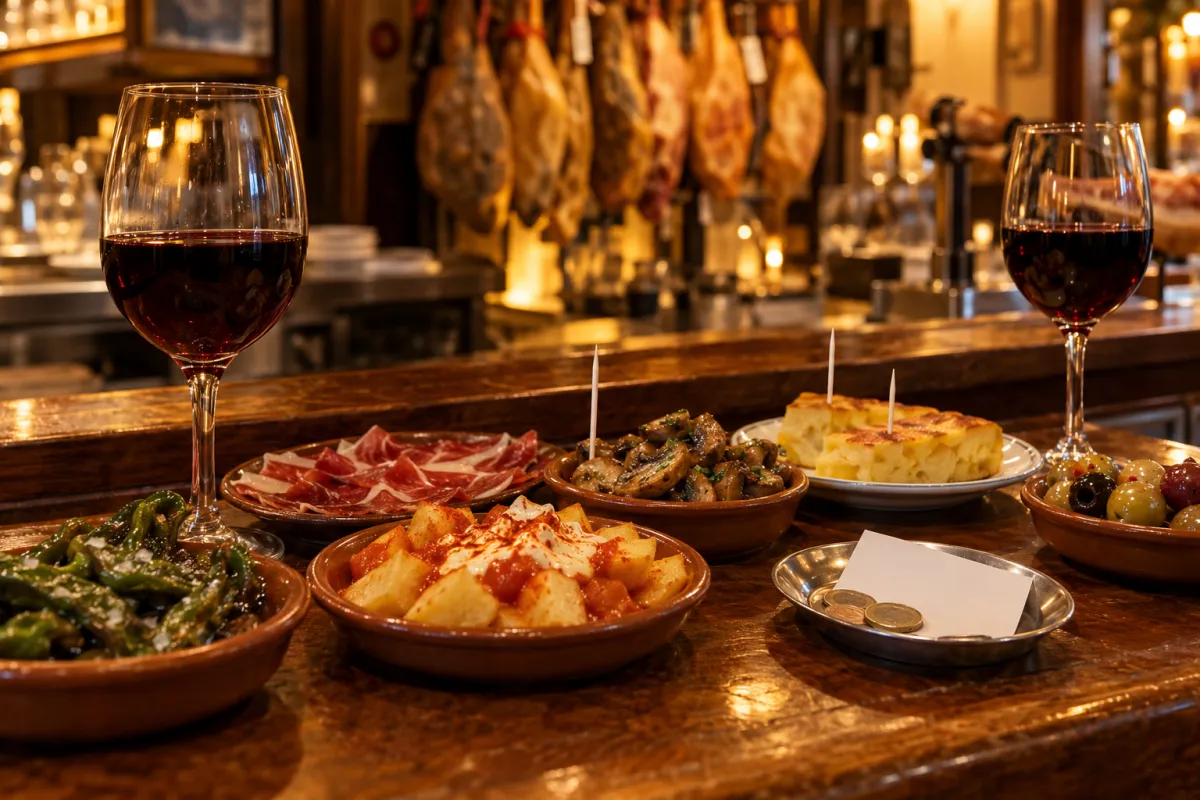
- Running tabs are common. The bartender keeps track of what you’ve had, sometimes on paper, sometimes in their head.
- Pay at the bar when you leave. Catch the bartender’s eye: “¿Qué te debo?” (What do I owe you?)
- Pintxos bars in the Basque Country sometimes count toothpicks or plates to work out your bill.
- Free tapas. In some cities, such as Granada, a small tapa traditionally comes with each drink. It’s part of the drink price, not something you pay extra for.

Worked example: tapas night for five
Illustrative prices, not quotes from a real bar. Five friends share plates and drinks; one doesn’t drink alcohol.
| Item | Amount |
|---|---|
| Shared tapas and raciones | €62.00 |
| Wine and beer (four drinkers) | €28.00 |
| Soft drinks (one person) | €5.00 |
| Total | €95.00 |
- Strict a escote (even split): €95 ÷ 5 = €19 each.
- Fairer for the non-drinker: food €62 ÷ 5 = €12.40 each; alcohol €28 ÷ 4 = €7 each. Drinkers pay €19.40, the non-drinker pays €12.40 + €5 = €17.40.
- Tip once: round the total up to €100, about €1 each.
In practice, many Spanish groups would simply do €20 each and call it even, tip included. Either is fine if everyone agrees, and the time to agree is before the first round, not when the bartender is waiting.
When you’re the guest
If Spanish friends or colleagues invite you out, expect a few things:
- A genuine offer to pay. When a local says “te invito,” especially to a visitor, they usually mean it. Accept warmly.
- A small tug-of-war is friendly. Offering once to contribute is polite; insisting repeatedly can feel like refusing their hospitality.
- Return the favor in kind. Buy the next round, pay for coffee the next day, or invite them when they visit you.
- Late hours are normal. Lunch often runs into mid-afternoon and dinner can start well after 9 pm, so the bill may arrive later than you’re used to.
Tipping, briefly
Tipping in Spain is optional and modest: small change in bars, about 5–10% for a really good dinner. Our full guide to tipping in Spain has the amounts by setting, card vs cash and the menú del día norms. In a group, tip once for the table rather than each person separately.
Spain vs other countries
| Country | Who usually pays | Splitting norm | Tipping / service |
|---|---|---|---|
| Spain | Inviter (“te invito”), or take turns | Even split (a escote) common; rounds in bars | Optional; small change to about 5–10% |
| Italy | Inviter, or split | Even split (alla romana) common | Optional; coperto often on the bill |
| Portugal | Inviter, or split | Even split common | Optional; pay the couvert only if you eat it |
| Germany | Inviter, or each pays | Separate payment very common | About 5–10%, said when paying |
| US and Canada | Inviter, or split | Separate checks common | 15–20% expected |
For another Mediterranean country, see our guide to tipping in Greece, where splitting the bill is called refené.
Phrases for paying the bill in Spain
| English | Spanish |
|---|---|
| The bill, please | La cuenta, por favor |
| Can you charge us? | ¿Nos cobras? |
| What do I owe you? | ¿Qué te debo? |
| It’s on me / I’m paying | Te invito / Os invito |
| Shall we go halves? | ¿Pagamos a medias? |
| Shall we split it equally? | ¿Vamos a escote? |
| Can we pay separately? | ¿Podemos pagar por separado? |
| This round’s on me | Esta ronda la pago yo |
| Can I pay by card? | ¿Puedo pagar con tarjeta? |
| Next one’s on me | La próxima la pago yo |

Common mistakes visitors make
- Waiting for the bill. Ask for it; nobody will bring it unprompted.
- Insisting on paying after someone said “te invito.” Thank them and get the next one instead.
- Itemizing a shared tapas table. With shared plates, splitting evenly is fairer and faster.
- Skipping your round. If you drank the rounds, buy one.
- Tipping US-style. 20% is far above local practice.
Sharing a table with new people
Spanish dining is social by design, and the “te invito / a escote” vocabulary is a reminder that the easiest bills are the ones everyone understood before ordering.
Want to turn this into an actual plan? MeetNow is a free app for meeting people in person: a host posts a plan at a public place, says who pays (host pays, split, pay your own or free) and picks who joins. It is live on the web now, starting in Malta, with the phone apps on the way: open MeetNow and see the plans near you.
FAQ: paying the bill in Spain
How do you ask for the bill in Spain?
Say “La cuenta, por favor.” In casual bars you’ll also hear “¿Me cobras?” or “¿Nos cobras?” (Can you charge me/us?). The bill usually doesn’t come until you ask.
What does “te invito” mean in Spain?
“Te invito” literally means “I invite you,” and in a bar or restaurant it means “I’m paying for you.” If someone says it, they are treating you.
What does “pagar a escote” mean?
It means each person pays their share of a common expense. The Real Academia Española defines “a escote” as each person paying the part that corresponds to them in a shared cost.
Is it normal to split the bill in Spain?
Yes. Among friends, splitting the total evenly is common, and so is taking turns paying for rounds. Asking for completely separate bills at a busy restaurant is less common, so say it early if you need it.
Do you pay at the bar or the table in Spain?
In tapas bars you often keep a running tab and pay at the bar when you leave. In sit-down restaurants, you ask for the bill at the table and pay there or at the register.
The bottom line
Paying the bill in Spain is relaxed once you know the vocabulary: ask for “la cuenta,” accept a “te invito” graciously, split a escote with friends, take your turn buying a round, and settle tapas tabs at the bar. Tip lightly, and enjoy the sobremesa.