Booking a table instead of cooking makes Christmas easier in every way but one: someone has to deal with the check. So who pays for Christmas dinner at a restaurant? The person who invites and organizes usually pays. When a whole family decides together to eat out, the common default is that each household pays its own share, with the guest of honor treated by everyone else. Grandparents who pick up the whole bill are giving a gift, not meeting an obligation.
This guide sorts out the usual setups, from a parent treating the family to friends booking a holiday lunch, then covers the restaurant practicalities that cause most of the friction: set menus, deposits, automatic gratuities on large parties and whether the restaurant will split the check. It ends with scripts for the invitation, the booking and the moment the bill arrives.
Christmas Day 2026 falls on Friday, December 25. Many restaurants that open on the day take bookings weeks in advance and run special menus, so the money conversation is best had in November, not at the table.
Who pays for Christmas dinner at a restaurant: the verdict
The principle is the same one that applies to any meal out: whoever invites usually pays. If your parents say “We’d like to take everyone out for Christmas dinner,” that is an invitation, and they are hosting. Guests can offer once to contribute, and if the answer is no, they say thank you and let it go.
Christmas is different from an ordinary dinner in one important way: very often nobody really invites anyone. The family simply decides, over a few messages, that this year it is easier to eat out. In that case there is no host, and the fair default is to split by household. Each couple or family unit covers its own members, and the group quietly shares the cost of anyone who is being treated.
Generosity runs the other way too. In many families an older relative, often a grandparent, likes to pay for everyone as their Christmas gift. That is lovely, and the right response is a sincere thank-you, not an argument. It is a gift, though, not a duty: nobody should assume that the oldest or wealthiest person at the table will cover it.
For the wider rules across family meals, dates and work dinners, see our main guide on who pays for dinner.

Christmas restaurant situations at a glance
Find your setup, then check the exceptions column before deciding which default fits.
| Situation | Usual norm | Exceptions |
|---|---|---|
| Parents invite adult children and partners | The parents pay as hosts. | Adult children may offer to cover wine or dessert; parents can accept or decline. |
| Family decides together to eat out | Each household pays its own share. | Grandparents or anyone visiting from far away are usually treated, with the cost shared. |
| Adult children take their parents out | The children pay, split between siblings. | Siblings with very different incomes may agree an unequal split privately. |
| Friends book a Christmas lunch together | Split evenly or pay for what you ordered, agreed in the invite. | If one friend explicitly says “my treat,” they pay. |
| Your partner’s family, first Christmas together | You are a guest. Offer once to pay your share; accept if they decline. | If the family splits by household, you and your partner count as one household. |
| In-laws host at a restaurant every year | They pay, as hosts. | Many couples reciprocate by hosting another holiday meal or brunch. |
| Office Christmas lunch | The company or manager pays if it is an official team event. | If coworkers organize it themselves, everyone usually pays their own. |
| A relative insists on paying for everyone | Let them, and thank them warmly. | If it would genuinely strain them, offer privately and quietly to contribute. |
If this is your first holiday meal with a partner’s family, the norms overlap with a first meal with the parents, which we cover in who pays when meeting the parents.
Splitting by household: how it works
Splitting by household is the fairest default for a group Christmas meal, but it only feels fair if everyone agrees on the details before the day.
Decide what counts as a household
Usually a couple, a family with children, or a single adult. Children are almost always paid for by their own parents. A grandparent living alone is a household too, but in many families they are treated by the others.
Decide how to handle the people being treated
The cleanest approach: add up the cost of the treated guests and divide it evenly between the paying households. If the group would rather keep it simple, the household that invited the grandparents can cover them.
Decide whether to split evenly or by what was ordered
With a fixed-price holiday menu, this solves itself: each household pays for the number of covers it brought. With an à la carte menu and a lot of wine, an itemized split is fairer, especially if one household doesn’t drink. Our guide to splitting a bill fairly walks through both methods with worked examples.
Choose one payer or separate checks
One person paying on one card and the others repaying quickly is the smoothest option at the table. Separate checks are possible at some restaurants, but large holiday bookings are often handled as one bill. Ask when you book.

Restaurant practicalities: set menus, deposits and gratuity
Most of the arguments about a Christmas restaurant meal are really surprises about the bill. These are the questions to ask when you book.
- Is there a set Christmas menu, and what is the price per person? Holiday set menus are common and make the total predictable. Check what is included: drinks are often extra.
- Is a deposit or card guarantee required? Many restaurants ask for one on busy holiday dates. Whoever puts down the deposit should be clear whether it is their treat or an advance the group will repay.
- Is a service charge or automatic gratuity added for large parties? Many US restaurants add one for big tables. Read the check before adding a tip on top, and if a service charge appears, it is fair to ask whether it goes to the staff.
- Will the restaurant split the check? Policies vary, and some won’t split large holiday bookings. Our guide on whether restaurants allow splitting the check covers what to ask and the polite workarounds.
- What is the cancellation policy? If someone drops out late, know whether the group still pays for their cover.
On the tip itself: in the US, tipping the server on a sit-down meal is standard, and holiday staff are working on a day most people have off. If there is no automatic gratuity, the payer or each household should tip on its share. In Canada, tipping norms for restaurant service are broadly similar.
If you want to avoid the money conversation at the table entirely, say who pays in the invitation. That one sentence does more than any etiquette rule, and it is exactly how plans work on MeetNow, where the host states who pays when posting a plan.
When the Christmas bill gets awkward
Even with a plan, a few situations come up again and again. Here is how to handle them gracefully.
One household ordered far more
If one family ordered cocktails, a second bottle of wine and the most expensive main while another kept it simple, an even split is not fair. Suggest, before the check arrives, that drinks are paid by whoever ordered them and the food is split as planned. Said lightly and early, this rarely offends anyone.
Someone can’t really afford it
Holiday meals out are expensive, and not everyone in a family has the same budget. If you know a sibling or cousin is stretched, a private word beforehand helps: offer to cover part of their share, or suggest a venue with a set menu at a gentler price. Never solve it publicly at the table.
Two people grab for the check
The classic Christmas tug-of-war, usually between a parent and an adult child. If you were not the host, let the host win. If nobody is the host, agree a rotation for next year: “You get this one, we get next Christmas.”
The restaurant will only issue one bill
Nominate one payer, photograph the itemized receipt, and settle up in the family group chat the same week. Agree in advance who that payer will be so nobody is surprised by a large charge.
Christmas Eve and other holiday meals
The same principles apply to a Christmas Eve dinner, a Boxing Day lunch or a holiday brunch: whoever invites pays, a group decision means a household split, and the guest of honor is treated. Families who alternate between houses often balance things by having one side host Christmas Eve at home and the other book a restaurant for Christmas Day.
Scripts for the invitation and the check
Parent hosting the family
“We’d love to take everyone out for Christmas dinner this year, our treat. We’ve booked for 1 pm on the 25th. Just let us know who’s coming.”
Organizer proposing a household split
“Thinking we book somewhere for Christmas lunch this year instead of cooking. Plan: each household pays its own share, and we all chip in to treat Mom and Dad. The set menu is about the same as a big grocery shop. Sound OK?”
Adult child offering to contribute when parents host
“Thank you so much for dinner. Can we at least get the wine? We’d really like to.”
Booking with the restaurant
“We’re booking for 12 on Christmas Day. Could you tell us the set menu price, whether there’s a service charge for large tables, and whether you can split the bill by family?”
Accepting a grandparent’s gift
“Grandpa, that’s so generous. Thank you, it’s been the best Christmas lunch. We’ll get the coffee next time we see you.”
Settling up afterward
“Total came to the amount on the photo of the receipt. Our household shares are in the group chat, including the tip and Grandma’s share split three ways. No rush, any time this week.”
Want to turn this into an actual plan? Open MeetNow and see the plans posted in Malta.
Frequently asked questions (FAQ)
Who usually pays for Christmas dinner at a restaurant?
The person who invited and organized the meal usually pays. If the family decided together to eat out, each household commonly pays its own share and the group shares the cost of anyone being treated, such as grandparents.
Should grandparents pay for the family Christmas dinner out?
Only if they want to. Many grandparents enjoy treating the family as a Christmas gift, and that should be accepted with thanks. It is never something the family should assume or expect.
How do you split a Christmas restaurant bill between families?
Count each couple or family as one household. With a set menu, each household pays for its own covers. With an à la carte bill, split by what each household ordered. Divide the cost of treated guests and the tip evenly between paying households.
Do you tip more on Christmas Day?
There is no rule, but many diners tip at the generous end of their usual range on holidays, because staff are working while others are off. Check first whether a service charge or automatic gratuity has already been added.
Is it rude to ask family to pay for their own Christmas dinner at a restaurant?
Not if it was agreed in advance. A household split proposed when the meal is planned is a normal, fair arrangement. What feels rude is presenting the bill as a surprise after the meal.
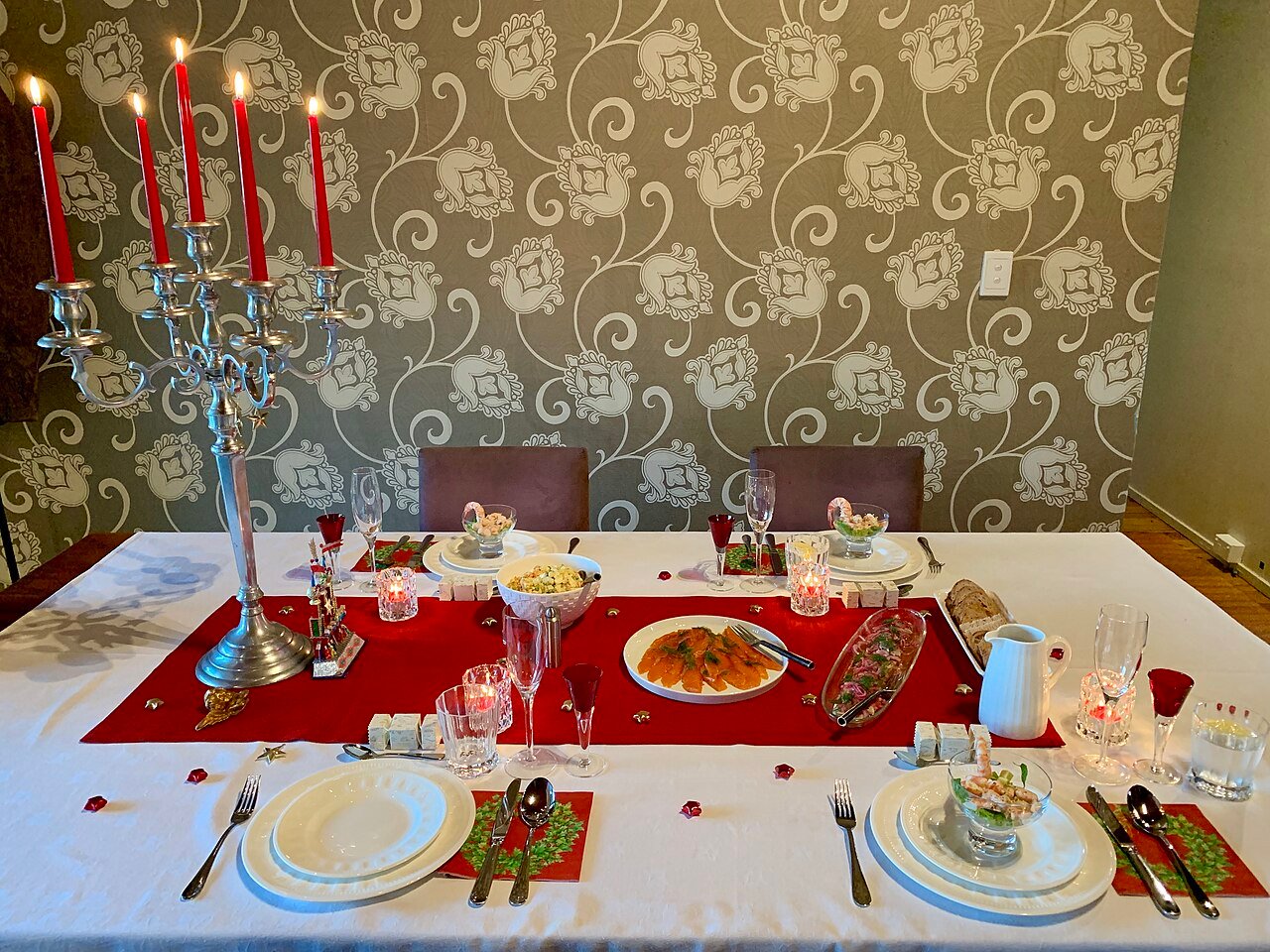
Featured image: Christmas Eve dinner table by Chris Olszewski / Wikimedia Commons, CC BY-SA 4.0.