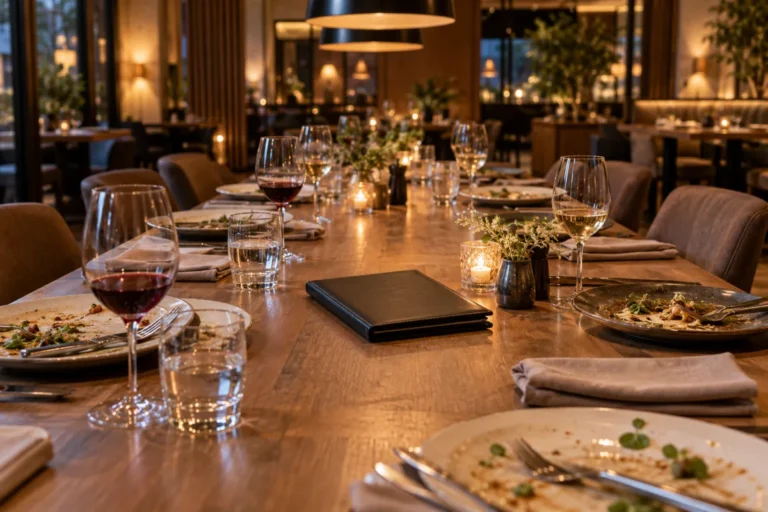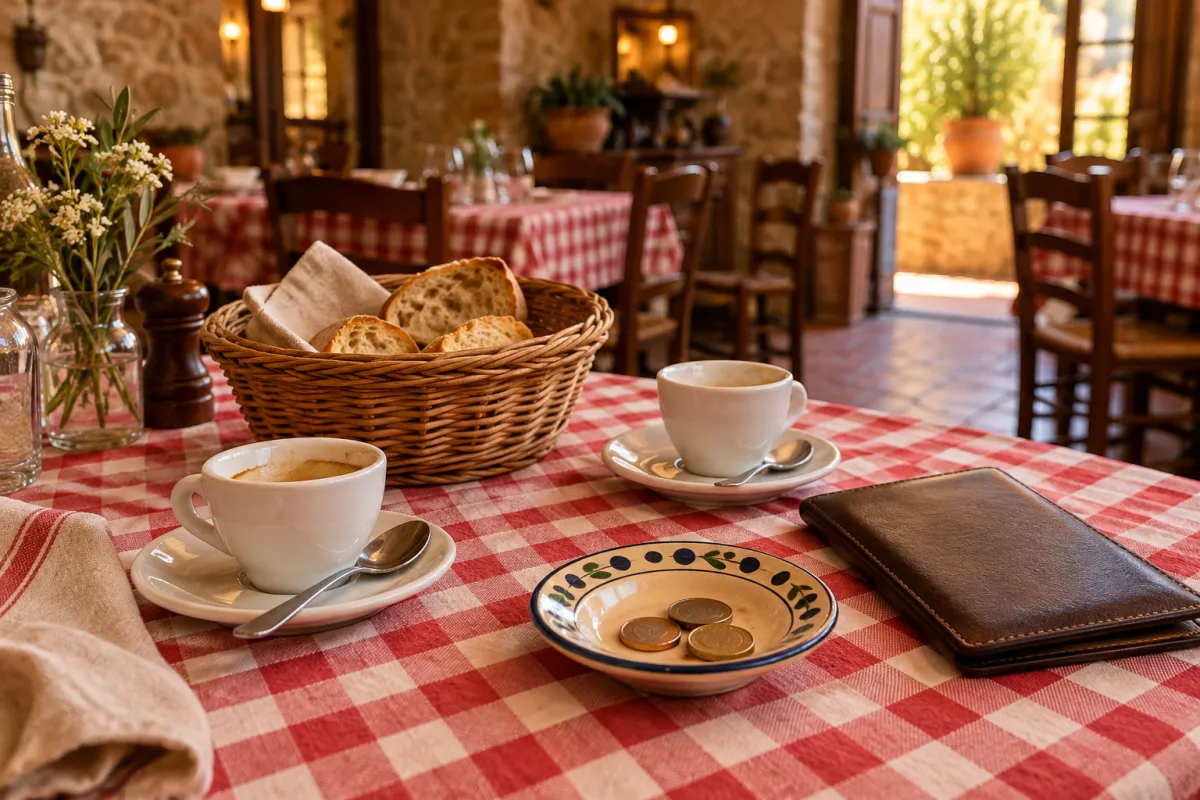
In Italy, the check does not arrive until you ask for it. A server who drops the bill while you are still finishing your espresso would seem to be rushing you out, so you can sit for a long time wondering why nobody brings it. That one difference explains most of the confusion North Americans feel when paying the bill in Italy. The pacing, the line items and the splitting customs all work a little differently from a restaurant in Chicago or Toronto.
The system is simple once you know four things. There is a small per-person cover charge. Tipping is optional. Restaurants have to accept cards. Groups of friends usually split the total evenly instead of asking for itemized checks. Everything else is a variation on those rules.
The same principles apply whether you are on a first date in Rome, on a group trip to Florence, or at a work dinner in Milan. Below are the line items, who usually pays in each situation, the exact phrases to use, ready-made scripts, and a comparison with other countries so you can adjust wherever you eat.
How Paying the Bill in Italy Works, Step by Step
The process has a clear order. Once you know it, nothing about the end of an Italian meal will catch you off guard.
- Finish at your own pace. At a sit-down restaurant, the table is generally yours for as long as you like. Lingering over coffee or a digestivo is normal, not rude.
- Ask for the check. Catch the server’s eye and say “Il conto, per favore.” Miming a signature in the air works too, and servers everywhere understand it.
- Read the bill. Look for the coperto, any service line (servizio), and drinks or bread you may not remember ordering. Questions are fine if you ask them politely.
- Pay where the place expects you to. At many trattorias and pizzerias, the server brings the bill to the table. At others, and at most coffee bars, you pay at the register (la cassa) near the door. If you are unsure, ask “Pago qui o alla cassa?”
- Take the receipt. The scontrino helps you check the total and is handy for expense reports on work trips.
Why the check doesn’t come automatically
In much of North America, a server brings the check soon after the plates are cleared. That keeps tables turning and can feel efficient. In Italy, a meal is treated as time you have reserved, not a transaction to wrap up. Bringing the bill before you ask can feel like a hint to leave. Asking for it is not impatient or demanding. It is simply how you signal that you are done.
Coffee bars work differently
At many busy coffee bars, especially in cities, you pay at the register first and then show your receipt at the counter to order. Prices at the counter are often lower than table-service prices, so sitting down at a bar table can change the total. If a bar posts a separate price for table service, that is normal and not a trick aimed at tourists.
What’s on an Italian Bill: Coperto, Servizio and Mancia
Three words do most of the work on an Italian check. Knowing them stops you from overtipping, undertipping or disputing a charge that is completely standard.
Coperto: the cover charge
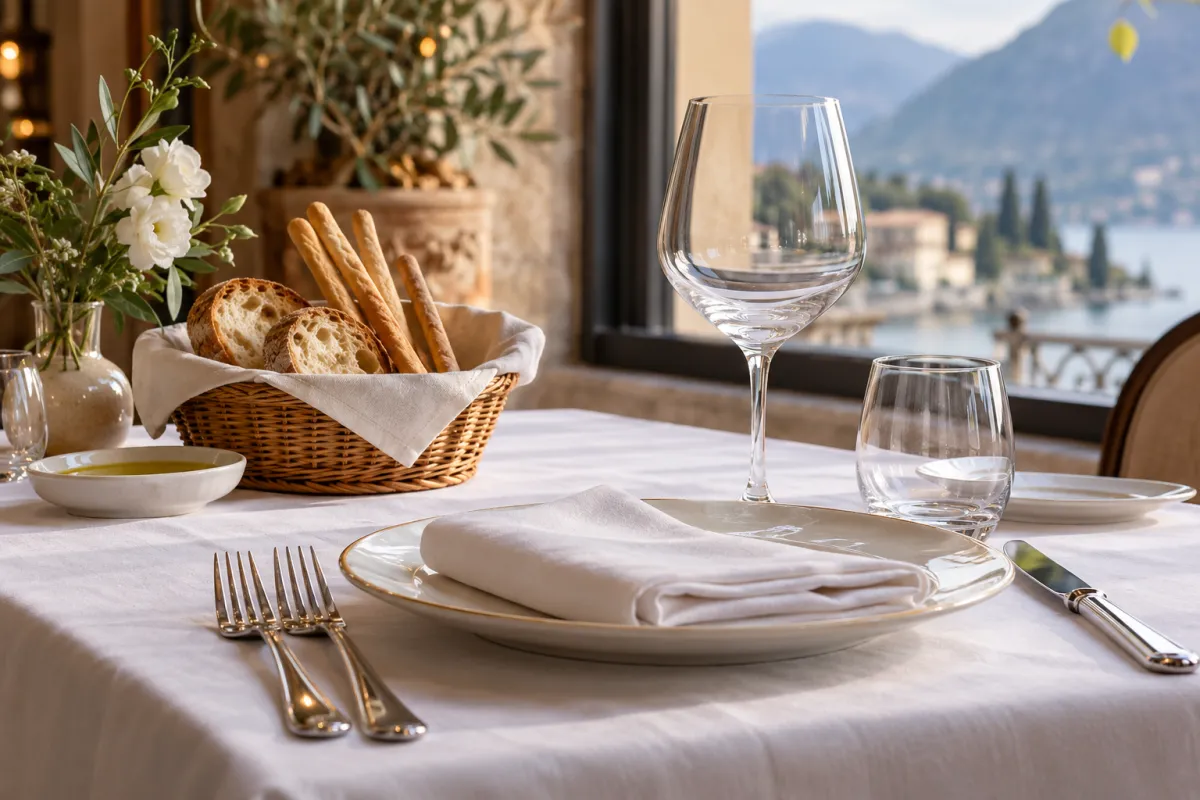
The coperto is a per-person cover charge, usually €1 to €3 and sometimes more at high-end tourist spots, that pays for the table setting, tablecloth, cutlery and bread (CIU Travel). It has to be printed on the menu. You cannot opt out by sending back the bread basket, because it is a charge for occupying the table and using the place setting. You may see it written as “pane e coperto” (bread and cover). For regional quirks and how to spot it on a menu, see our full guide to the coperto in Italy and how servizio differs.
Servizio: a service line
Some restaurants, more often in heavily visited areas, add a service charge, shown as servizio. If a service line already appears on the bill, you do not need to tip on top of it. If you are unsure, ask “Il servizio è compreso?” (Is service included?). The server will tell you directly, and the question is not awkward.
Mancia: the tip
Tipping in Italy is a thank-you, not part of what the meal costs. Servers are paid a wage and do not depend on tips the way many North American servers do. If service was exceptional, the usual gesture is to round up to the nearest €5 or €10 note or leave a €1 or €2 coin per person, not a calculated percentage (ItaliaRail). Cash is the simplest way to leave it.
For US and Canadian travelers: Leave your home percentage habit at home. Tipping in Italy the way you would in Boston or Vancouver won’t offend anyone, but it is far more than locals leave. Round up for good service, add a little more when someone went out of their way for you, and leave nothing extra when a service line is already on the bill.
Who Pays in Italy: Dates, Friends, Family and Work
The bill itself is straightforward. Who picks it up depends on the relationship. Italy has no single rule, but some patterns come up again and again.
On a date
The person who extends the invitation usually offers to pay, often with a light “Offro io” (my treat). Expectations around gender vary by generation, region and the individual couple, so don’t assume. Many couples who have been out a few times take turns, or the other person covers coffee or a drink afterward. If you were invited and want to contribute, offer once, sincerely. If the offer is declined, accept graciously and suggest you get the next one.
If you are meeting someone new, the usual safety basics apply in every country. Choose a public place, tell a friend where you’ll be, arrange your own way home, and leave if anything feels off. You never owe anyone your company because they paid for a meal.
With friends
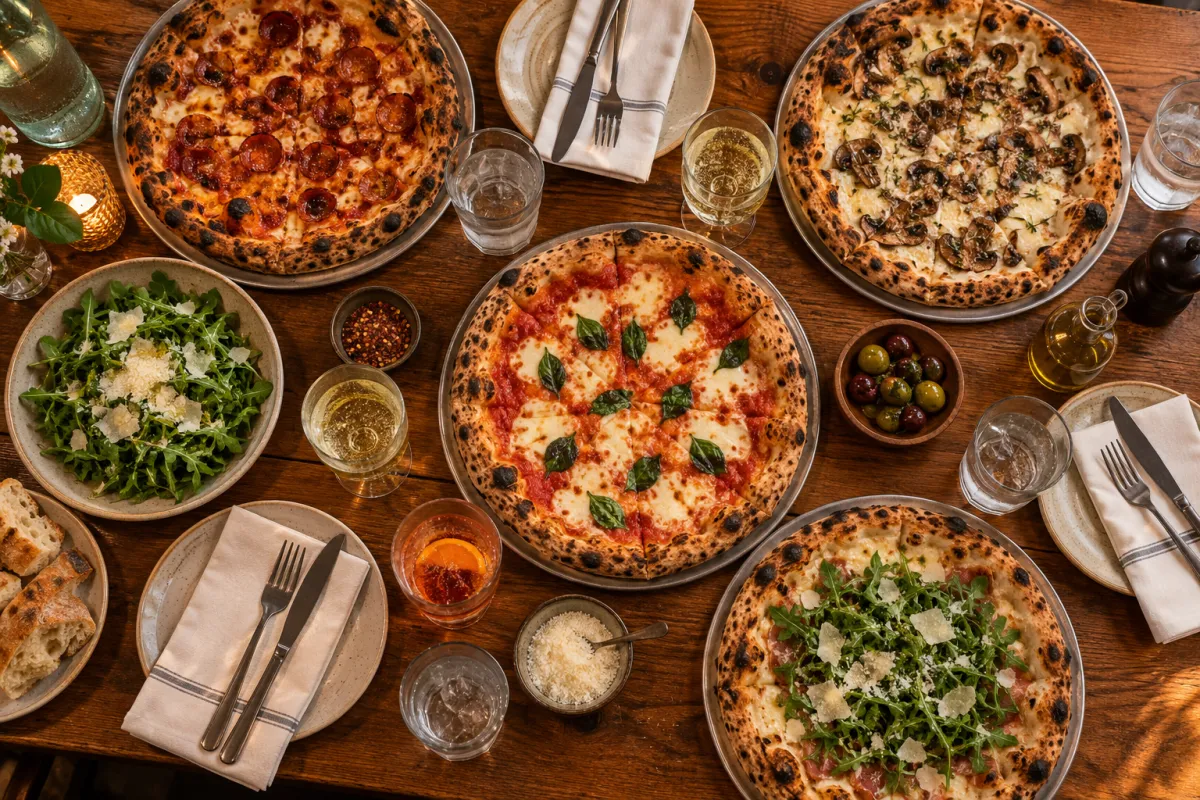
Among friends and peers, the default is splitting the total equally, or pagare alla romana. It is especially common after casual meals like pizza, where everyone orders similar things. Our explainer on the alla romana meaning and how Italians split the bill covers where the phrase comes from and the regional debates over what it means.
With family or local hosts
If an Italian friend’s family takes you out, the host typically pays, and arguing over the check can come across as refusing their hospitality. Offer once or twice, then accept with real thanks. Return the gesture later with coffee, a small gift or an invitation of your own.
Work dinners
At business meals, whoever issued the invitation, or their company, generally pays. With colleagues on a work trip, check before you go whether the meal goes on a company card or whether each person expenses their own. Getting this settled in advance spares everyone an awkward moment when the check arrives.
Splitting the Bill in Italy: Alla Romana vs Separate Checks
This is where North Americans most often get tripped up. At home, asking for separate checks is routine. In Italy, it usually isn’t.
Alla romana: one total, divided evenly
Pagare alla romana means dividing the full bill equally among everyone at the table, regardless of who ordered what. It is fast, it keeps the end of the meal relaxed, and among friends it tends to even out over many dinners. Say “Facciamo alla romana?” and everyone knows what you mean.
Why conti separati are rare
Itemized separate checks (conti separati) are not standard in Italy. Many restaurant POS systems are not set up to split items per diner, and asking a busy server to divide a complicated bill item by item can cause friction. That’s especially true with a big group in a full dining room. If you need to pay strictly for what you consumed, Italian practice offers two smooth options:
- Do the math at the table. Use a phone calculator, add each person’s share of the coperto, and hand over one payment.
- One person pays, the rest reimburse. One person pays the restaurant and the others pay them back in cash or by a transfer app. Agree on this before you sit down so nobody gets stuck covering the group.
Some places will run a few cards for equal shares if you ask politely and the restaurant isn’t slammed. Don’t count on it with a large group.
When an even split isn’t fair
An even split works when everyone orders roughly the same. It feels unfair when one person skipped wine or ordered a salad while others shared expensive bottles. The tactful move is to raise it early, ideally before ordering: “I’m not drinking, so I’ll just cover my food, if that works for everyone.” For more wording, see our scripts on how to ask to split the bill in any situation.
Cards, Cash and Italy’s POS Rule
Many travelers still hear that Italy is cash-only. The law says otherwise. Under Article 15, paragraph 4 of Decree-Law No. 179/2012, converted into Law No. 221/2012, restaurants, cafes and other businesses must accept card payments, and there is no minimum transaction amount (Confcommercio). Since June 30, 2022, a business that refuses a card payment can face an administrative fine of €30 plus 4% of the refused transaction (PagamentiDigitali.it).
There is one legitimate exception: objective technical impossibility. A real network outage or a broken terminal counts, so a restaurant can genuinely be unable to take your card at that moment.
Practical advice
- Carry some cash anyway. It is the easiest way to tip, and it saves you if the terminal is down.
- Ask before you order if it matters. “Si può pagare con la carta?” avoids surprises at small family-run places.
- Stay calm if a card is refused. A polite “Il POS non funziona?” (Is the card machine not working?) usually sorts things out. On vacation, paying cash and moving on is often the best choice, even when you are within your rights.
Who Pays Around the World: Italy vs the US, Germany, Korea and More
If you travel or date across cultures, it helps to see the norms side by side. These are general tendencies, not rules. Individuals, families and couples everywhere make their own arrangements.
| Country | Who usually pays | Splitting norm | Tipping / service |
|---|---|---|---|
| Italy | Inviter or host; friends share | Equal split (alla romana); separate checks uncommon | Coperto on menu; tipping optional, round up |
| United States | Often the person who invited; splitting common among friends and couples | Separate checks widely available | Percentage tip expected; tax added at the end |
| Canada | Similar to the US | Separate checks common; card terminal often brought to the table | Percentage tip expected |
| Germany | Inviter pays if they say so; otherwise each pays their own | Server asks “zusammen oder getrennt?” and splits at the table | Round up or add a small tip when paying |
| South Korea | Inviter or most senior person often pays; others reciprocate | Splitting more common among peers and younger people | Tipping not customary |
| Japan | Senior person may pay more; friends share | Warikan (equal split) common | No tipping |
| Spain | Inviter or rotating rounds | Equal split (a escote) common among friends | Tipping modest and optional |
| United Kingdom | Increasingly split or alternated | Splitting common | Discretionary service charge may appear on bill |
Two neighbors share Italy’s even-split habit, though their rituals differ. Japan’s warikan and the register routine are covered in our guide to whether you need cash in Japan. Spain’s a escote follows similar logic among friends.
Who pays on a date in the US
There is no single answer to who pays on a date in the US, and that is part of the stress. A common convention is that the person who asked offers to pay, especially on a first date. Splitting is widely accepted, and many couples alternate as things progress. The polite move for the invited person is a genuine offer to contribute. Unlike in Italy, the check usually arrives without asking, separate checks are easy to request, and the tip is calculated on top of the total. A generous Italian round-up would look stingy in a US restaurant.
Dating etiquette in Germany: who pays
Dating etiquette in Germany on who pays is more matter-of-fact than in Italy. When the bill comes, the server often asks “Zusammen oder getrennt?” (together or separate?), and splitting the check, even on a date, is unremarkable. If someone says “Ich lade dich ein” (I’m inviting you), it means they are paying. Tips are usually stated aloud when you pay, rather than left on the table. Our guide to splitting the bill in Germany has the phrases and the tipping script.
Who pays on a date in Korea
Who pays on a date in Korea often comes down to reciprocity rather than a strict split. One person might pay for dinner while the other covers coffee or dessert afterward. Taking turns over several dates is common, and many younger couples split outright. In wider social settings, age and seniority can shape who reaches for the check. Tipping isn’t expected in Korean restaurants either; see our guide to tipping in Korea for how to say thanks instead.
Phrases to Ask for the Bill in Italian
You don’t need fluent Italian to handle the check. These phrases cover almost every situation, and a “per favore” (please) and “grazie” (thank you) go a long way.
| Italian | Meaning | When to use it |
|---|---|---|
| Il conto, per favore. | The check, please. | The standard request, anywhere |
| Ci porta il conto, per favore? | Could you bring us the check? | A slightly more formal version |
| Pago qui o alla cassa? | Do I pay here or at the register? | When you’re unsure where to pay |
| Si può pagare con la carta? | Can I pay by card? | Before ordering or paying |
| Il servizio è compreso? | Is service included? | Before deciding on a tip |
| Facciamo alla romana? | Shall we split it evenly? | With friends, before the bill arrives |
| Offro io. / Pago io. | My treat. / I’ll pay. | When you are hosting |
| Ognuno paga il suo. | Everyone pays their own. | Agreeing on shares within the group |
| Tenga il resto. | Keep the change. | Leaving a small tip in cash |
Scripts for Common Situations
First date, you invited
Ask for the check, then say: “This one’s on me. I asked you out.” If they insist on splitting: “Okay, how about you get the gelato on the walk?” It keeps things balanced without a standoff.
First date, you were invited
“Can I chip in?” If they decline: “Thank you, that’s really kind. Next coffee is mine.” Then follow through.
Group birthday dinner in Italy
Before ordering, someone sets the plan: “Let’s do alla romana and cover the birthday person between us. Everyone okay with that?” When the bill comes, one person pays and the others send their share, so nobody has to ask the server to divide it.
Traveling with friends who spend differently
“Want to do the math at the table this time? I’m skipping wine.” Say it early and casually. Splitting by person is only awkward when it comes as a surprise at the end.
Being treated by an Italian host
“Please, let me contribute.” If they refuse: “Grazie mille. Then the next dinner is on us, and I’m not taking no for an answer.” Warmth matters more than winning the argument.
Quick Checklist Before You Pay
- Agree on how you’re splitting before you order, not when the bill lands.
- Check the menu for the coperto so the total doesn’t surprise you.
- Look for a servizio line before deciding on a tip.
- Have a card ready, plus a little cash for tips or terminal outages.
- Ask for the bill. It won’t come on its own.
- For uneven orders, calculate shares yourselves or have one person pay and collect.
Get those right and paying the bill in Italy becomes the easiest part of the meal.
Want to turn this into an actual plan? MeetNow is a free app for meeting people in person: a host posts a plan at a public place, says who pays (host pays, split, pay your own or free) and picks who joins. It is live on the web and works in your browser, starting in Malta; the phone apps are not in the App Store or Google Play yet. Open MeetNow and see the plans posted in Malta.
Paying the Bill in Italy: FAQ
Do you have to pay the coperto in Italy?
Yes. The coperto is a per-person cover charge for the table setting, cutlery, tablecloth and bread, and it must be listed on the menu. You cannot remove it by refusing the bread basket, because it is a charge for using the table and place setting.
Should I tip at restaurants in Italy?
Tipping is optional in Italy because servers are paid a wage and don’t rely on tips. For great service, round up the bill or leave a small coin per person in cash. Skip the extra tip if a service charge (servizio) is already on the bill.
Can I ask for separate checks in Italy?
You can ask, but itemized separate checks are not standard, and many restaurant systems aren’t set up for them. The smoother options are to split evenly (alla romana), to calculate each person’s share at the table, or to have one person pay and let the others reimburse them.
Can a restaurant in Italy refuse to take my card?
Italian law requires restaurants and other businesses to accept card payments with no minimum amount, and businesses that refuse can be fined. The exception is a genuine technical problem, such as a network outage or a broken terminal, so carrying some cash is still wise.
Who pays on a first date in Italy?
The person who invited usually offers to pay, often by saying “Offro io.” Expectations vary by generation and couple, so the invited person can offer to contribute. If the offer is declined, accept graciously and suggest covering the next coffee or drink.
Why doesn’t the waiter bring the check in Italy?
Bringing the bill before you ask can feel like rushing guests out, so Italian servers wait for you to request it. Catch the server’s eye and say “Il conto, per favore,” or mime a signature in the air.