The short answer
Japanese bill splitting warikan style means dividing the total bill evenly by the number of people, no matter who ate or drank what. One person, usually the organizer, takes the bill, announces the amount per head, collects cash or app transfers, and pays at the register. Among friends and peers it is the normal, polite default. With bosses, elders or the person who invited, the split often tilts so the senior person pays more or covers everything. There is no tipping. Last checked November 2026.
What warikan means
Warikan (pronounced wa-ree-kahn) is the Japanese word for splitting a bill. According to Wiktionary, it combines the character for “divide” with the one for “bill,” and is a shortening of warimae kanjō, roughly “share-based accounting.” In everyday speech it almost always means an even split per head.
English speakers often translate it as “going Dutch,” but the two are not identical. Going Dutch usually means everyone pays for what they ordered. Warikan means everyone pays the same share of the total. If you need to ask for the bill or for separate payment in other countries, our guide to asking for the bill in different languages has the phrases.
Japanese even has playful words for the side effects. Someone who ate and drank a lot “wins” the warikan (warikan-gachi), and the light eater who paid the same “loses” it (warikan-make). The terms exist precisely because people accept the small unfairness in exchange for simplicity.
Japanese bill splitting warikan step by step
The mechanics are simple, and they explain why the even split became the norm. In most Japanese restaurants the bill comes as one slip for the table and you pay at the register by the door, not at the table. Our guide on whether you need cash in Japan walks through paying at the register and where cards or cash work.
- The organizer asks for the bill. In Japanese, “okaikei onegaishimasu.” The slip often arrives in a folder or clipped to a board.
- They divide the total by the headcount and usually round up to a clean number, such as the nearest ¥100 or ¥500.
- They announce the amount. “Hitori sanzen-en desu” means “It’s ¥3,000 per person.”
- Everyone hands over cash or sends the amount by app. In Japan, PayPay’s money-transfer feature is widely used for this.
- The organizer pays at the register with the collected cash or their own card.
- Any small surplus from rounding goes toward the next round, or back to whoever paid by card.
Nobody studies the receipt line by line, and doing so at the table can feel petty. The trade-off is speed and harmony: a group of eight can settle up in a minute.

A worked example in yen
Illustrative numbers. Six friends share plates and drinks at an izakaya. The bill, including a small per-person seating charge, comes to ¥19,740. USD figures assume roughly ¥150 to the dollar; exchange rates move, so check the current rate.
| Method | Per person | Approx. USD | Notes |
|---|---|---|---|
| Exact warikan (¥19,740 ÷ 6) | ¥3,290 | about $22 | Accurate, but fiddly with coins |
| Rounded warikan | ¥3,300 | about $22 | ¥60 surplus goes to the next round or the card payer |
| Weighted: 2 seniors ¥4,500, 4 others ¥2,700 | ¥4,500 / ¥2,700 | about $30 / $18 | Totals ¥19,800; common with mixed ages or ranks |
| Non-drinker discount: 5 drinkers ¥3,500, 1 non-drinker ¥2,240 | ¥3,500 / ¥2,240 | about $23 / $15 | Kind gesture when one person had only tea |
Notice that each method lands on the total without anyone itemizing. That is the spirit of warikan: settle quickly, keep it friendly, adjust only for obvious differences.
Variants: weighted splits, treats and separate checks
Weighted warikan
When ages or ranks differ, a straight even split can feel wrong. Groups then use a weighted split, sometimes called keisha warikan (a “sloped” split): bosses, senior colleagues or older friends pay a bigger share, and students or junior staff pay less. Nobody needs to announce a formula; the organizer simply quotes two or three amounts.
Gochisō: the treat
Sometimes one person pays for everyone. A boss treating the team, a senior friend celebrating a younger one’s new job, or a parent taking adult children out are all common. The guest’s role is to thank them warmly, often with “gochisōsama deshita” as you leave, and again the next time you meet.
Betsu-betsu: separate payment
Paying individually, “betsu-betsu de,” is accepted at many cafés, ramen shops and family restaurants, especially when it’s not busy. At a crowded izakaya at peak time, staff may prefer one payment per table, so be ready to pay together and settle up afterwards.
When warikan applies and when it doesn’t
| Situation | Common practice |
|---|---|
| Friends or classmates of similar age | Even warikan |
| Office drinking party (nomikai) | Often weighted; seniors pay more, or the company or boss covers part |
| Welcome or farewell party for a colleague | The guest of honor usually pays nothing; others split |
| A date | Varies; even splits are common, and men paying more or all is also common |
| Business meal with a client | The host company pays |
| Older relative with younger family | The elder usually treats |
Dating is its own topic, with survey data and phrases, in our guide to who pays on a date in Japan. And for comparison with a neighbor where the inviter or most senior person often pays and tipping isn’t expected either, see our guide to tipping in Korea.

Phrases to use at the table
| Say (romaji) | Meaning |
|---|---|
| Warikan ni shimashō | Let’s split it evenly |
| Okaikei onegaishimasu | The bill, please |
| Hitori ikura desu ka | How much per person? |
| Betsu-betsu de onegaishimasu | Separately, please |
| Koko wa watashi ga haraimasu | I’ll get this one |
| Gochisōsama deshita | Thank you for the meal (said to the cook or to whoever treated you) |
One more tip: tipping is not customary in Japan, so the amount you divide is the amount you pay. If a seating charge or service charge appears on the bill, it is simply part of the total. More on that in our guide to tipping in Japan.
Bringing warikan to a US or Canadian table
Warikan works anywhere, and it is often the least stressful option for groups whose orders were similar. To adapt it in North America:
- Agree before ordering. “Let’s just split it evenly” works best when said early, not when the check lands.
- Include tax and tip in the total before dividing, so the per-person amount is final.
- Carve out obvious outliers. If one person skipped alcohol or a bottle of wine was shared by only some, adjust those first, like the non-drinker discount above.
- Let one person pay and collect by app, the North American version of the organizer at the register.
When orders differ a lot, itemizing is fairer; our guide on how to split the bill fairly compares even and itemized splits with worked examples.
The deeper lesson from warikan is that agreeing on the rule matters more than which rule you pick. Want to turn this into an actual plan? MeetNow is a free app for meeting people in person: a host posts a plan at a public place, says who pays (host pays, split, pay your own or free) and picks who joins. It is live on the web and works in your browser, starting in Malta: open MeetNow and see the plans posted in Malta.
Frequently asked questions (FAQ)
What does warikan mean?
Warikan means splitting a bill, usually evenly, among everyone at the table. The word combines the characters for “divide” and “bill” (kanjō). It is the closest Japanese equivalent of going Dutch.
Is it rude to split the bill in Japan?
No. Warikan is completely normal among friends, classmates and colleagues of similar rank. What can feel awkward is splitting item by item at the table; an even split per head is the default.
Do seniors pay more in warikan?
Often, yes. At work dinners and with mixed ages, a weighted split is common: senior colleagues or the person who invited pay a larger share, and younger or junior members pay less.
Can you ask for separate checks in Japan?
Many casual restaurants accept betsu-betsu (separate payment) at the register, especially at quiet times, but some busy izakaya prefer one payment per table. Asking politely is fine; be ready to pay together and settle up afterwards.
Do you tip when splitting the bill in Japan?
No. Tipping is not customary in Japanese restaurants. Some places add a seating charge or a service charge, which is simply part of the total you divide.
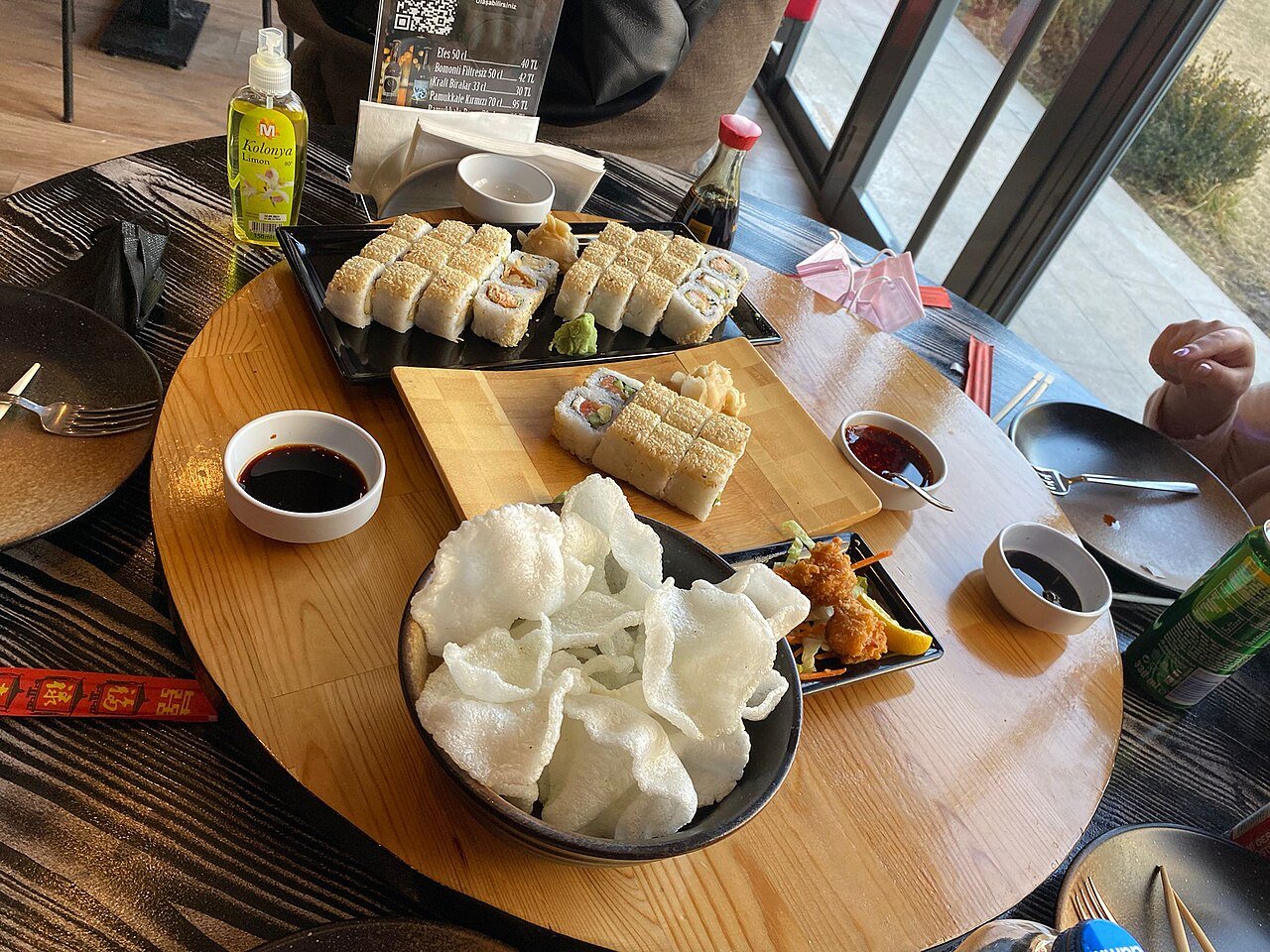
Featured photo: shared plates of sushi rolls, prawn crackers and dipping sauces on a round wooden table, by Nadiredg, CC0, via Wikimedia Commons.