The short answer
In Germany, when you ask for the bill, the server will often ask “Zusammen oder getrennt?”, which means “Together or separately?” Paying separately at the table is completely normal, even for couples and small groups. Each person says what they had, the server works out each total, and you pay on the spot. To tip, you usually tell the server the total you want to pay, including the tip, or say “Stimmt so” (“keep the change”). Rounding up or adding about 5–10% is common.
This guide covers what “zusammen oder getrennt” means and how to answer, how to tip in Germany, cash vs card, whether Germans split on dates, and a phrase table you can use at the table. Last checked October 2026.
What “zusammen oder getrennt” means
“Zusammen” means together; “getrennt” means separately. When you ask for the bill (“Die Rechnung, bitte” or “Zahlen, bitte”), the server will often bring a handheld device or a notepad to your table and ask which you would like.
- “Zusammen, bitte.” One person pays the whole bill.
- “Getrennt, bitte.” Each person pays for their own items. The server will usually ask each of you what you had and give you your individual total.
This is one of the most practical customs a North American visitor can learn. There is no need to ask for separate checks at the start, as you would in the US. In many German restaurants and cafes, splitting by person is simply built into how paying works.
How “getrennt” works step by step
- Catch the server’s eye and say “Zahlen, bitte” or “Die Rechnung, bitte.”
- The server asks “Zusammen oder getrennt?”
- Answer “Getrennt, bitte.”
- The first person lists what they had: “Ein Schnitzel und ein Bier.”
- The server tells you your total, for example “Achtzehn fünfzig” (€18.50).
- You say the amount you want to pay including tip, for example “Zwanzig, bitte” (€20), or hand over cash and say “Stimmt so.”
- The next person does the same.

How to tip in Germany
Tipping in Germany is smaller than in the US and handled differently. According to the UK Post Office’s travel money tipping guide, a service charge is included in the bill, but adding 5–10% or rounding up is common. The German word for a tip is “Trinkgeld,” literally “drink money.”
Say the total, do not leave it on the table
The usual method is to tell the server the total you want to pay before they hand you change or run your card:
- Bill is €27.40; you want to pay €30: say “Dreißig, bitte” or “Machen Sie dreißig.”
- Paying cash and want them to keep all the change: say “Stimmt so.”
- Paying by card: say the total you want charged before they enter the amount.
Rounding up the bill is commonplace in Germany, often with the comment “stimmt so,” as noted in Wikipedia’s sourced list of tipping customs. Leaving coins on the table after the server has already given you change is less common and can be missed.
How much to tip
| Situation | Typical tip |
|---|---|
| Sit-down restaurant, good service | About 5–10%, or round up |
| Cafe or bar | Round up to the next convenient amount |
| Beer garden with self-service | Usually none at the counter |
| Taxi | Round up the fare, or add about 10% (Post Office guide) |
For a southern European contrast, see our guide to tipping in Greece.
Cash vs card in Germany
Germany has long been known as a cash-loving country, and cash is still common, but card use is growing fast. The Deutsche Bundesbank’s latest study of payment behavior in Germany found that cash was used for 45% of payments in 2025, down 6 percentage points from 2023, so for the first time more than half of purchases were cashless, according to its June 2026 press release. Even so, cash was still the single most-used way to pay.
What this means for visitors:
- Carry some cash. Small cafes, bakeries, beer gardens and traditional inns may prefer cash or have a minimum for cards.
- Ask before you order if you can only pay by card. “Kann ich mit Karte zahlen?” (“Can I pay by card?”)
- Splitting by card is fine. With “getrennt,” each person can pay their own share by card.
- Add the tip when you pay. Tell the server the total including the tip before they key in the card amount.

Do Germans split the bill on dates?
Paying separately is common in Germany in many situations, and the “zusammen oder getrennt” question means splitting on a date is a normal, visible option rather than an awkward request. That said, it would be a stereotype to claim that all Germans always split on dates. Plenty of people treat, take turns, or follow the same “whoever invited pays” idea that is common in North America.
A few practical points:
- Answering “getrennt” is not a statement. On an early date it is ordinary and not read as a lack of interest.
- Answering “zusammen” is a clear way to treat. If you want to pay, simply say “Zusammen, bitte” when the server asks.
- If you are unsure, ask your date. “Shall I get this, or would you like to split?” works in any language.
For the words to ask to pay separately in other countries, see our guide to asking for the bill in different languages.
Groups and shared items
“Getrennt” works best when each person ordered their own items. It gets trickier with shared starters, bottles of wine or a round of drinks. A few tips:
- Decide on shared items before the server arrives. “We’ll split the wine between the three of us.”
- Let one person pay for shared items. Then settle up between yourselves.
- Take turns buying rounds. In bars and pubs, taking turns is one way groups keep it simple.
- For big groups, it can be faster for one person to pay “zusammen” and everyone else to pay them back.
If you settle up among yourselves, our guide to splitting the bill fairly shows how to share tax and tip in proportion. And if you are nervous about raising the subject at home in North America, our guide on how to ask to split the bill has scripts for every situation.
Phrases table: paying in German
| English | German | Rough pronunciation |
|---|---|---|
| The bill, please | Die Rechnung, bitte | dee RECK-noong, BIT-teh |
| We’d like to pay | Zahlen, bitte | TSAH-len, BIT-teh |
| Together or separately? | Zusammen oder getrennt? | tsoo-ZAH-men OH-der geh-TRENT |
| Together, please | Zusammen, bitte | tsoo-ZAH-men, BIT-teh |
| Separately, please | Getrennt, bitte | geh-TRENT, BIT-teh |
| Keep the change | Stimmt so | shtimmt zoh |
| Make it 30, please | Dreißig, bitte / Machen Sie dreißig | DRY-sik, BIT-teh |
| Can I pay by card? | Kann ich mit Karte zahlen? | kan ikh mit KAR-teh TSAH-len |
| I’ll get this | Ich lade dich ein | ikh LAH-deh dikh ine |
“Ich lade dich ein” literally means “I’m inviting you,” and it is the natural way to say a meal is your treat.

A worked example: three friends pay “getrennt”
Three friends finish dinner at a Gasthaus. Prices on German menus already include sales tax (VAT), so what you see on the menu is what you pay before any tip.
| Person | What they had | Their total | What they say | Pays |
|---|---|---|---|---|
| Lena | Main course and a small beer | €18.50 | “Zwanzig, bitte.” | €20.00 |
| Max | Main course, two beers | €24.80 | “Siebenundzwanzig, bitte.” | €27.00 |
| Sam | Soup and a soft drink | €11.20 | Hands over €12 cash: “Stimmt so.” | €12.00 |
Each person rounds up by roughly 5–10%, nobody has to do group math, and the whole thing takes about a minute. Compare that with a single North American check for the same table, which would need splitting, a tax line and a 15–20% tip.
Paying in different kinds of German venues
Sit-down restaurants (Restaurant, Gasthaus, Wirtshaus)
This is where “zusammen oder getrennt” is most common. The server comes to the table, you say how you want to pay, and you settle there. In traditional inns you may also see a “Stammtisch,” a table reserved for regulars; it is polite not to sit there unless you are invited.
Cafes and bakeries
In many cafes you order and pay at the counter, especially for coffee and cake. In table-service cafes, the same “together or separately” question applies when you ask to pay.
Beer gardens and markets
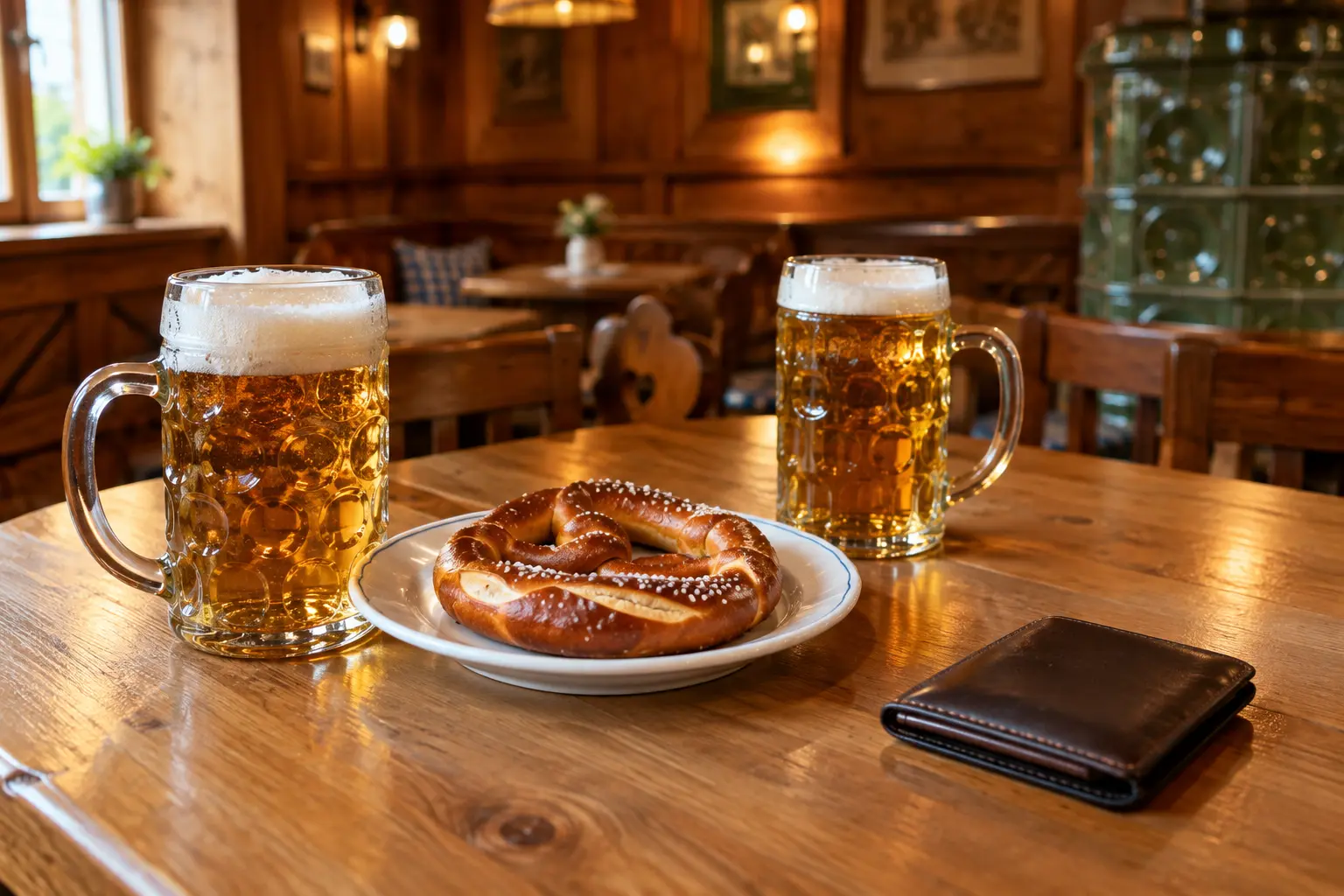
Many beer gardens are partly self-service: you collect food and drinks from stalls and pay as you go, so everyone naturally pays their own. The Post Office guide notes that at markets and festivals you may pay a deposit on a glass and get it back when you return it, so it helps to have small change.
Bars and pubs
Some bars run a tab and settle at the end; others take payment with each round. If you are in a group, taking turns buying rounds is one easy way to keep it fair.
How to get the server’s attention
German service can feel more hands-off than North American service. Servers often leave you alone until you signal that you need something, which is a sign of respect for your time at the table, not neglect.
- Make eye contact and raise a hand slightly.
- Say “Entschuldigung” (“excuse me”) as they pass.
- When they arrive: “Wir möchten zahlen, bitte” (“We’d like to pay, please”).
Austria and other German-speaking places
The “together or separately” question and the habit of saying the total you want to pay are also familiar in Austria. The Post Office guide notes that service is often added to Austrian bills, and that leaving a few extra euros is welcome for excellent service, or 5–15% if no service charge has been added. Customs vary by place, so watch what locals do and ask when in doubt.
Common mistakes visitors make
- Waiting for the bill to appear. In Germany, as in much of Europe, you usually need to ask for it.
- Leaving the tip on the table after getting change. Say the total instead, or “stimmt so.”
- Assuming card is always accepted. Ask first, especially in small or traditional places.
- Tipping US-style 20%. Rounding up or about 5–10% is plenty.
- Feeling awkward about “getrennt.” It is a normal answer, not a rude one.
Germany vs North America at a glance
| Germany | US and Canada | |
|---|---|---|
| Asking for the bill | You ask; it is not brought automatically | Often brought without asking |
| Splitting | Server asks “together or separately?” | Ask for separate checks when ordering |
| Typical tip | Round up or about 5–10% | 15–20% of the pre-tax bill |
| How you tip | Say the total, or “stimmt so” | Write it on the slip or select on the terminal |
| Cash | Just under half of payments (45% in 2025) | Card is dominant in most restaurants |
Say who pays before the bill comes
Germany’s “zusammen oder getrennt” question is a neat solution to an awkward moment: it makes the choice explicit. The same idea works anywhere, as long as someone says it before the bill arrives.
Want to turn this into an actual plan? MeetNow is a free app for meeting people in person: a host posts a plan at a public place, says who pays (host pays, split, pay your own or free) and picks who joins. It is live on the web now, starting in Malta, with the phone apps on the way: open MeetNow and see the plans near you.
Frequently asked questions
What does “zusammen oder getrennt” mean?
It means “together or separately?” German servers often ask it when you request the bill. Answer “zusammen” if one person is paying, or “getrennt” if each person pays for their own items.
Do Germans split the bill?
Paying separately is very common in Germany, among friends, coworkers and often on dates. It is not universal, though; people also treat each other or take turns. The server’s question simply makes splitting easy.
How much should you tip in Germany?
Rounding up or adding about 5–10% for good service is common. Tell the server the total you want to pay, including the tip, rather than leaving money on the table.
What does “stimmt so” mean?
“Stimmt so” means roughly “that’s right” or “keep the change.” Say it when you hand over cash and want the server to keep the difference as a tip.
Is cash still common in Germany?
Yes. In the Bundesbank’s 2025 study, cash was used for 45% of payments, down from 51% in 2023, and it was still the single most-used payment method. Card use is growing, but carrying some cash is still wise, especially in small cafes and traditional inns.
The bottom line
In Germany, splitting the bill is so normal that the server asks for you. Answer “zusammen” or “getrennt,” say the total you want to pay to include a modest tip, carry a little cash, and you will pay like a local.