The short answer
Dinner with strangers events come in five main formats: app-matched restaurant dinners (such as Timeleft), host-cooked ticketed meals (such as Eatwith), supper clubs and pop-ups listed on event sites, Meetup dinner groups, and communal or chef’s tables at restaurants. To find one near you, search the apps and event platforms for your city plus “supper club”, “social dining” or “dinner club”, then vet each listing before you book: what the ticket covers, how the bill works, group size, where it happens and the cancellation policy. Most confusion and awkwardness come from one question, who pays for the food, so settle it before the night. Last checked November 2026.
Types of dinner with strangers events
“Dinner with strangers” covers several very different experiences. The format decides how you book, how many people you meet and, above all, how the money works. If you are new to the idea, our complete guide to dinner with strangers explains the concept; this page focuses on finding and choosing an actual event.
| Format | How it works | How payment works | Typical group |
|---|---|---|---|
| App-matched restaurant dinner (e.g. Timeleft) | You sign up, answer questions, and get matched with a small table at a partner restaurant, usually on a set weekday | A ticket or membership for the matching; your meal and drinks are a separate restaurant bill | Around 4–6 people |
| Host-cooked ticketed meal (e.g. Eatwith) | A host lists a menu, date and price; guests book seats at their home or venue | You pay the listed price when booking; drinks or extras may be noted separately | Varies by host, often 6–12 |
| Supper club or pop-up dinner | A chef or host runs a ticketed dinner, often a set menu, announced on event sites or social media | Ticket usually covers the set menu; check whether drinks, tax and gratuity are included | From 8 to dozens |
| Meetup dinner group | Members RSVP to a restaurant meal organized in a group | Usually everyone pays for what they order at the restaurant | Depends on RSVPs |
| Communal table or chef’s table | You book a seat at a shared table in a restaurant | Normal restaurant bill, often per person | Whoever booked that seating |
| Small group plan | Someone posts a dinner plan at a public restaurant and picks who joins | The plan states who pays: host, split, pay your own or free | Usually 3–8 |
Prices for all of these vary by city and change often, so we do not quote fixed figures. Check the current price on the booking page, and read our Timeleft vs Eatwith comparison for how the two best-known services differ on cost and format.
Where to find dinner with strangers events near you
Work through these sources in order. Most people find a suitable event within the first three.
- Dedicated apps. Open Timeleft and check whether your city is listed and which dates are open. Do the same for Eatwith, filtering by your city and the dates you are free.
- Event platforms. On Eventbrite, search your city with “supper club”, “dinner club”, “social dining” or “community dinner”. Filter to the next four weeks so you only see upcoming events. Our guide to supper clubs near you lists more places to search.
- Meetup. Search “dinner”, “foodies” or “restaurant club” near you. Look for groups that have held events regularly over the past couple of months, not just one in the distant past.
- Restaurants. Ask local restaurants whether they run communal tables, chef’s table nights or regular themed dinners. Some only announce these by newsletter or social media.
- Community calendars. Libraries, community centers, faith communities and neighborhood associations sometimes run shared suppers, especially around the holidays.
- Your own plan. If nothing fits, host a small dinner at a public restaurant and state the payment rule upfront. It is often easier to fill four seats than to find the perfect event.
If you live in a big city, there will usually be more choice, and if you are in New York, our guide to tipping in NYC covers what to add when the bill arrives.

How to vet a listing before you book
A quick check prevents most bad surprises. Run every listing through these seven questions:
- What does the ticket cover? Matching only, a set menu, or menu plus drinks? Write it down.
- Who pays for the food, and how? Separate checks, one bill split evenly, or prepaid? This is the question that causes the most friction at the table.
- Are tax and gratuity included? Ticketed dinners sometimes include them; restaurant bills almost never do. Budget for both if the listing is silent.
- How many people? Four to eight is ideal for real conversation. Large events are livelier but harder to connect at.
- Where exactly? A public restaurant or venue is the easiest first step. For home-hosted meals, check that the platform shows the host’s history and reviews.
- What is the cancellation policy? Some tickets are non-refundable within a set window. Know the deadline before you pay.
- Can they handle your diet? Set menus may not adapt. Ask before booking, not at the table.
If a listing cannot answer most of these clearly, choose another one. Good hosts are happy to explain. Once you have booked, a quick read of supper club etiquette covers what to bring and how tipping works.
What happens on the night
- Before you leave: reread the booking, note the address and the payment rule, and tell a friend where you are going.
- Arrival: arrive on time or a few minutes early. Introduce yourself with your first name and one easy detail (“I’m Jess, I moved here in the spring”).
- Ordering: at restaurant formats, order within your budget. Nobody expects you to match the most expensive order at the table.
- Conversation: ask open questions and pass the conversation around. Quiet guests often warm up once food arrives. Keep a few questions to ask at a dinner with strangers in mind.
- The bill: follow the rule the event set. If none was set, suggest separate checks before the server totals anything.
- After: if you clicked with someone, swap contacts or suggest the next event together.
Going solo? That is normal at most of these events, and if you’d rather start with a solo meal, our tips on eating alone at a restaurant cover where to sit and what to do while you eat.
Who pays at each type of event
The fair default when strangers share a meal is that everyone pays for what they ordered, including their share of tax and tip, unless the event said otherwise in advance. In practice:
- App-matched dinners: your fee covers the matching; you pay the restaurant for your own food and drinks. We explain paying for your own food at Timeleft in more detail.
- Host-cooked and supper club tickets: the ticket covers what the listing says. Anything extra, such as drinks you order, is yours.
- Meetup groups and communal tables: pay your own unless the organizer announced a different rule before ordering.
- Small group plans: whatever the host stated when posting: host pays, split, pay your own or free.
If you are curious how a supper club differs from a regular dinner party in this respect, see our explainer on what a supper club is and how tickets work.

Scripts for hosts and tables
Asking a host before you book
“Hi, I’m interested in the dinner on the 12th. Does the ticket include drinks, tax and tip, or should I budget for those separately?”
Setting the rule at the table
“Shall we ask for separate checks before we order? It makes the end much easier.”
When the bill arrives as one check
“How about everyone covers what they ordered plus tax and tip? I can add mine up first.”
Declining an even split politely
“I only had the pasta and water, so I’ll put in for mine plus tip, if that works for everyone.”
Safety basics
Choose events at public venues for your first few, tell a friend where you are going and who organized it, arrange your own way home, and keep your drink with you. If anything feels off, leave; a simple “I need to head out, lovely to meet you all” is enough. For home-hosted meals, book only through platforms that show host history and reviews.
Want to turn this into an actual plan? MeetNow is a free app for meeting people in person: a host posts a plan at a public place, says who pays (host pays, split, pay your own or free) and picks who joins. It is live on the web and works in your browser, starting in Malta: open MeetNow and see the plans near you.
Frequently asked questions (FAQ)
How do I find dinner with strangers events near me?
Check dedicated apps such as Timeleft and Eatwith for your city, then search Eventbrite and Meetup for “supper club”, “dinner club” or “social dining” with your city name. Restaurants with communal or chef’s tables and community calendars are good backups.
How much do dinner with strangers events cost?
It depends on the format and city. App-matched dinners charge a fee for the matching and you pay for your own meal; host-cooked and supper club dinners usually charge a ticket that covers the set menu. Check each listing for what is included, including tax and tip.
Do you pay for your own food at a dinner with strangers?
Usually yes, at restaurant-based formats: everyone pays for what they ordered plus their share of tax and tip. At ticketed dinners, the ticket covers the menu and you pay only for extras you order.
Is it safe to go to a dinner with strangers event?
Most events take place in public restaurants or through platforms that show host reviews. Stick to public venues at first, tell a friend where you are going, arrange your own way home and leave if you feel uncomfortable.
Can I go to a dinner with strangers event alone?
Yes. Most guests come alone, which is the point of the format. Arrive on time, introduce yourself to the people next to you and ask open questions.
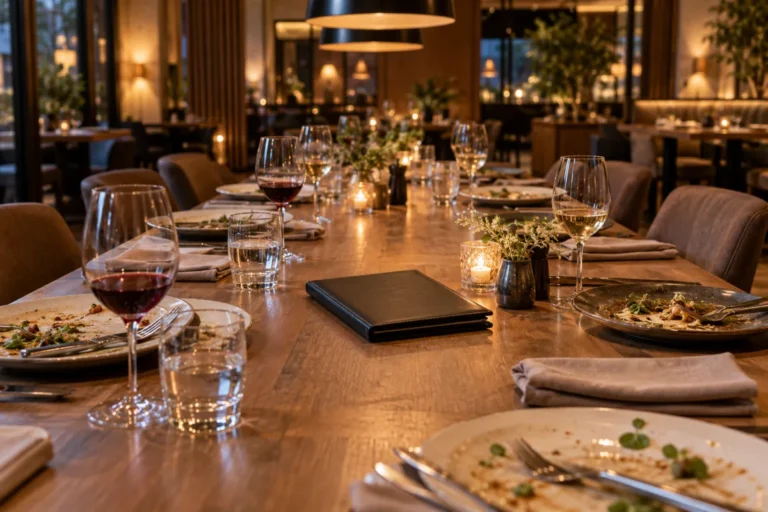
Featured photo: a banquet table setting at the Palais Niel, Toulouse, by Traumrune, CC BY-SA 3.0, via Wikimedia Commons.