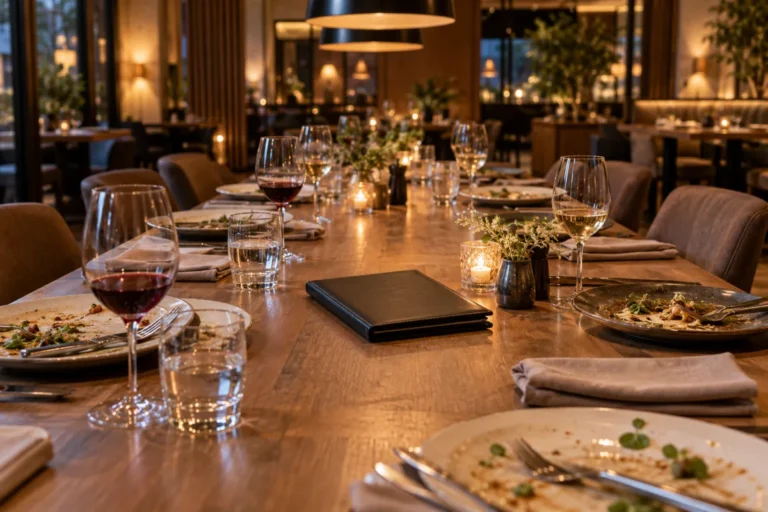
Short answer: A dinner with strangers is a meal where you sit down with people you have never met, usually through an app, a home-hosted dining platform, a supper club or simply a shared table. In most formats you pay for your own food and drinks. Ticketed formats (supper clubs, home-hosted dinners) are usually prepaid per seat, while matched restaurant dinners charge a booking fee and then each guest pays the restaurant for what they order. Agree on separate checks at the start, tip on your own share and nobody has to do awkward math at the end.
Eating with people you don’t know sounds odd until you try it. A shared meal gives everyone something to do with their hands, a natural reason to talk and a clear end time. That is exactly why dinner-with-strangers formats have spread through US and Canadian cities: they make meeting new people feel less like networking and more like going out to eat.
The part nobody explains well is the money. Who pays at a dinner where nobody invited anybody? Is the table splitting evenly? Do you tip the host of a home dinner? This guide answers those questions format by format, then walks you through what the evening looks like, what to say when the bill arrives and how to stay safe.
What “dinner with strangers” actually means
The phrase covers several different set-ups. They share one idea (a table of people who are new to each other) but differ in who organizes the meal, where it happens and how payment works:
- Matched restaurant dinners. An app groups you with a handful of people, picks a restaurant and books the table. Timeleft is the best-known example in North America.
- Home-hosted dinners. A cook hosts paying guests at their home or a private space. Eatwith is the best-known marketplace for this.
- Supper clubs. Recurring dinners run by a chef or an organizer, often with a set menu and a single seat price. Some are listed publicly, others travel by word of mouth or a mailing list.
- Communal tables. Restaurants with long shared tables where you may end up next to strangers simply because that’s the seating.
- Self-organized small plans. Someone posts an invite to a meetup group, a club or a community board (“dinner at a Thai place Thursday, 6 seats”) and people sign up.

Formats compared: how each works and who pays
The table below sums up how the main formats handle the bill. Prices change and vary by city, so we have only included details the services publish themselves, and you should confirm on the official site before you book. To find an actual event in your city and check a listing before paying, see our guide to finding dinner with strangers events.
| Format | How it works | How payment works | Typical cost |
|---|---|---|---|
| Matched restaurant dinner (e.g. Timeleft) | You answer a questionnaire, get placed in a small group and receive the restaurant details shortly before the dinner | Booking fee or subscription to the app; according to Timeleft’s help center, the meal is not included and each guest pays for their own food and drinks at the restaurant | Booking fee varies by city and plan, plus whatever you order |
| Home-hosted dinner (e.g. Eatwith) | A host lists a menu, date and seat price; you book a seat online | Prepaid when you book; Eatwith’s host help center says a 30% guest service fee is added on top of the host’s price | Set per seat by the host |
| Supper club | Set menu, fixed date, one long table or a few shared tables | Usually a ticket bought in advance; drinks may be included, extra or BYOB | Set by the organizer; check what the ticket includes |
| Communal table at a restaurant | You’re seated at a shared table next to other parties | Each party has its own check, as at any other table | Normal menu prices |
| Self-organized small plan | An organizer posts the place, time and number of seats; people ask to join | Whatever the organizer states: usually pay your own, sometimes an even split or the host treats | Normal menu prices |
Last checked October 2026.
The one rule that covers every format
Find out how payment works before you sit down. If it’s prepaid, you know your number. If it isn’t, the default with strangers is simple: everyone pays for what they ordered. Nobody at a dinner with strangers is “the host” in the sense of picking up the tab, unless someone explicitly says so in the invitation.
How payment works at the table
Prepaid formats are easy. The tricky ones are the restaurant-based dinners, where five or six people who met an hour ago have to settle a bill together. Here is how to keep it painless.
Ask for separate checks at the start
Servers in the US and Canada are used to separate checks, but it’s much easier for them if they know before the first order. Timeleft’s own guidance suggests discussing payment preferences at the start of the dinner, and says it asks restaurants to allow individual payments. That is good advice for any format: one sentence when you order saves ten minutes of confusion later.
Even split or pay your own?
Some tables decide to split evenly because it’s faster. That only works when everyone ordered roughly the same. If you had a salad and water while someone else had two cocktails and a steak, an even split quietly asks you to subsidize them. You are allowed to say no, politely, and pay your own share. Our guide on how to split the bill fairly has worked examples of both approaches.
Tipping on your share
In the US, tipping 15–20% of the pre-tax amount at a sit-down restaurant is the common range, and in Canada the norm is similar. When everyone pays separately, each person tips on their own portion. If the restaurant adds an automatic service charge for large parties (many do for groups of six or more), check the bill before adding more. Supper clubs and home-hosted dinners vary: if a service fee or gratuity is built into the ticket, an extra tip is optional.
Bring a backup
Splitting one table across six cards takes time, and occasionally a restaurant’s system struggles with it. Timeleft suggests bringing some cash just in case. Even a small amount lets you cover your share plus tip if the card machine becomes the bottleneck.
What to expect, step by step
Formats differ, but most dinners with strangers follow the same arc:
- Booking. You reserve a seat, answer a few questions or ask to join a posted plan. Note dietary needs at this stage if the format allows it.
- The reveal. Some formats keep the venue or your tablemates secret until shortly before. Axios Denver, reviewing Timeleft in 2024, described getting a few details about the group the night before and the location on the day of the dinner.
- Arrival. Arrive on time or a few minutes early. Being the first one there is easier than walking up to a table where everyone has already started talking.
- Introductions and ordering. First names, what brought everyone, then menus. This is the moment to mention separate checks.
- The meal. Expect two hours or so for a restaurant dinner. Hosted dinners and supper clubs often run longer with multiple courses.
- The bill. Prepaid formats skip this. Otherwise each person settles their own check and tip.
- After. Some groups continue to a bar; many swap numbers or social handles. Nobody is obliged to do either.
Going to a dinner with strangers alone
Most people at these dinners arrive alone. That’s the point: the format is designed for people who are new in town, whose friends have moved away or who simply want to meet someone outside their usual circle. Going solo is normal, and in matched formats it’s often the only way to book.
A few things make the first one easier:
- Have two or three openers ready. “How long have you lived here?”, “What made you sign up?” and “What’s the best thing you’ve eaten in this city?” work at almost any table.
- Ask follow-up questions. People remember the person who was curious about them far more than the person with the best story.
- Don’t carry the table. If conversation stalls, that’s everyone’s job, not yours alone.
- Keep plans light afterward. If you click with someone, suggest something specific and low-key: coffee, a walk, a game. If you want more ideas for meeting people regularly, see our list of cheap hobbies to meet people.
Dinner with strangers etiquette
The etiquette is mostly ordinary good manners, with a few points specific to tables of strangers:
- Don’t over-order on someone else’s tab. If the table is splitting evenly, order in line with everyone else or opt out of the split.
- Don’t assume someone is treating. Unless an organizer clearly said “my treat,” assume you pay your own. If someone offers to buy a round, thank them and keep it to one round.
- Share the airtime. Notice who hasn’t spoken and ask them a question.
- Skip the hard sell. It’s a dinner, not a pitch meeting. Talking about your work is fine; recruiting the table is not.
- Respect dietary choices. No commentary on what anyone eats or drinks, including whether they drink alcohol.
- Leave gracefully. “This was great, I’m heading out, thanks everyone” is all you need. Make sure your share is paid before you go.

Scripts for the money moments
The awkward moments at a dinner with strangers almost always involve the bill. These lines keep it friendly. For more variations, see how to ask to split the bill.
When ordering
“Before we order, would separate checks be easiest for everyone? I’ll ask our server.”
When someone suggests an even split you don’t want
“I had something pretty small, so I’ll just pay for mine if that’s OK. Happy to throw in for any shared plates.”
When shared plates complicate things
“Let’s split the appetizers evenly between the people who had them, and everything else goes on our own checks.”
When someone offers to treat the table
“That’s really generous, thank you. Next round’s on me if we go somewhere after.”
When you’re the organizer of a small plan
“Dinner at [restaurant] on [day] at 7, six seats. Everyone pays their own; I’ll ask for separate checks when we sit down.”
Saying who pays in the invitation is the single best way to avoid confusion. It’s the same principle behind the classic rule covered in our guide to who pays for dinner: whoever organizes sets the expectation, and everyone else can decide whether it works for them before they say yes.
Safety basics when meeting strangers for dinner
Keep it simple and sensible:
- Meet in a public place. A restaurant, a busy café or a well-reviewed venue, not a private address you don’t know, unless it’s a home-hosted dinner booked through a platform with clear host details.
- Tell a friend where you’re going, who organized it and when you expect to be home.
- Arrange your own way home and don’t depend on someone you just met for a ride.
- Watch your drink and your limits. You can always switch to water.
- Leave if you feel uncomfortable. Pay your share, say goodbye and go. You don’t owe anyone an explanation.
Is a dinner with strangers worth it?
It depends what you’re after. If you want guaranteed new best friends, no format can promise that. If you want a low-pressure way to get out of the house, try a new restaurant and have a few real conversations, it’s one of the easiest options available. Cost-wise, the cheapest version is a self-organized plan where everyone pays their own at an affordable place; the priciest is usually a chef-led supper club with a set menu.
The best results come from repeating it. One dinner gives you a few names; showing up to the next one (or inviting someone from the first table to a follow-up) is where friendships actually start.
Want to turn this into an actual plan? MeetNow is a free app for meeting people in person: a host posts a plan at a public place, says who pays (host pays, split, pay your own or free) and picks who joins. It is live on the web now, starting in Malta, with the phone apps on the way: open MeetNow and see the plans near you.
FAQ
Do you pay for your own food at a dinner with strangers?
Usually, yes. At restaurant-based formats each guest pays for what they order. Timeleft’s help center states that the meal isn’t included in the reservation. Supper clubs and home-hosted dinners are the exception: the seat price is typically paid in advance and covers the food.
Should the table split the bill evenly?
Only if everyone agrees and ordered similar amounts. With strangers, separate checks are the fairer default. It’s fine to say you’d rather pay for your own.
How much should I tip at a dinner with strangers?
Tip on your own share as you would at any US or Canadian restaurant; 15–20% is the common range. Check first for an automatic service charge on large-group bills, and for prepaid dinners check whether gratuity is already included.
Is it weird to go to a dinner with strangers alone?
No. Most guests come alone, and many formats are built for solo sign-ups. Arriving on time and having a couple of easy questions ready makes the first few minutes much easier.
What should I bring to a supper club?
Check the listing: some are BYOB, some include drinks. Beyond that, bring your payment method, any dietary information you didn’t submit in advance and an open mind about who you’ll sit next to.
How do I stay safe at a dinner with people I don’t know?
Meet in a public place, tell a friend your plans, arrange your own transportation and leave whenever you feel uncomfortable. Pay your share before leaving so nobody is left with your bill.