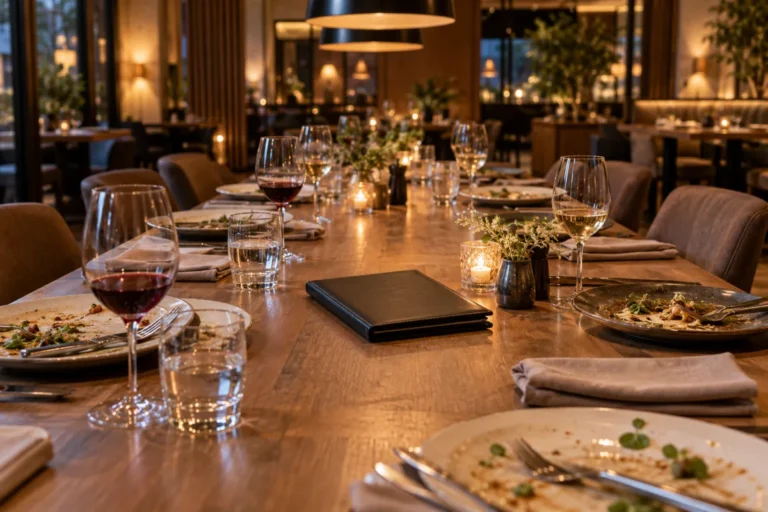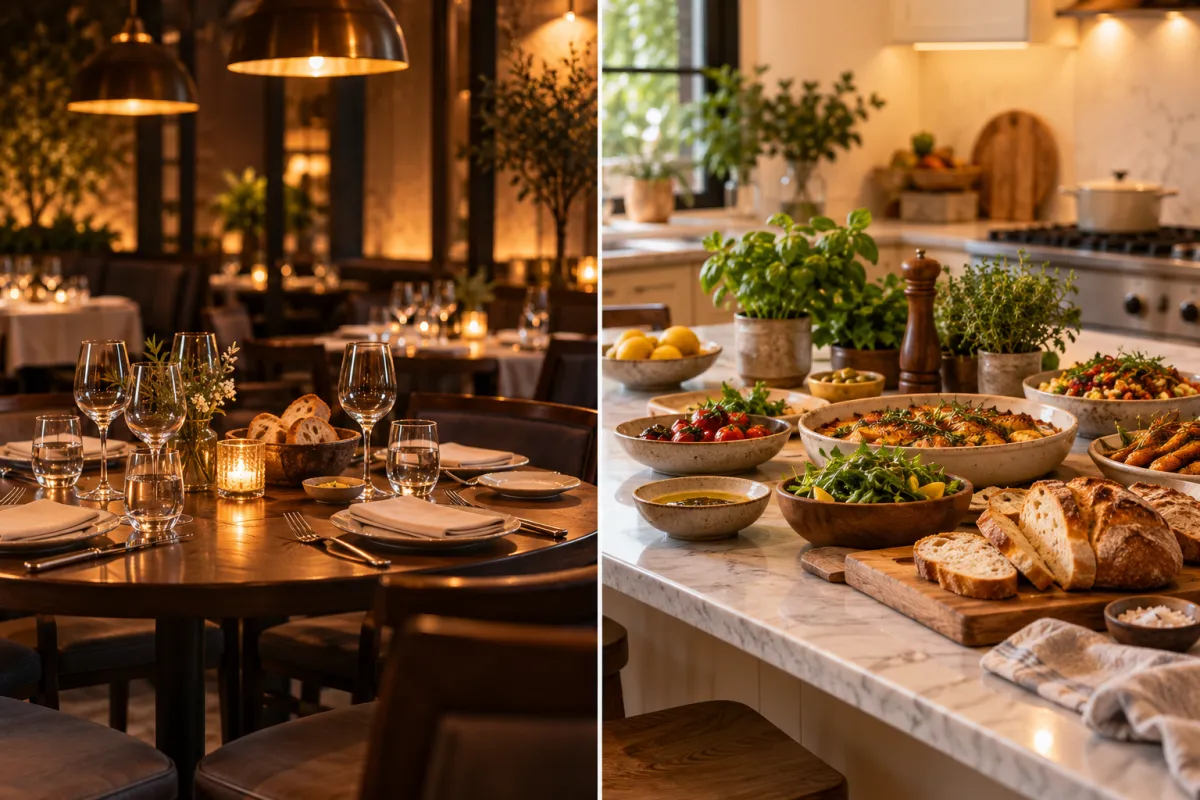
The Timeleft vs Eatwith choice comes down to one practical question: what does your money actually pay for? On Timeleft, a membership matches you with a small group of strangers and reserves a table at a restaurant. You then pay the restaurant yourself for whatever you eat and drink. On Eatwith, you book a meal that a local host cooks and serves, often in a private home, a loft or on a rooftop, at a price the host sets on the listing.
That single difference shapes everything else. It decides how the bill lands, whether a tip is expected, how much the food matters compared with the company, and how relaxed the end of the meal feels. If you have just moved to a new city, or your friend group has thinned out, both can get you to a table with new people. They just do it in very different ways.
Below you will find our verdict, a side-by-side table, what each meal looks like step by step, scripts for the money moments and the safety basics we would give any friend meeting strangers over a meal.
Timeleft vs Eatwith at a glance
Both services put you at a table with people you have never met. The money works in opposite directions, though. Timeleft charges for access and leaves the meal to you. Eatwith charges for the meal and the host handles the rest. Here is how they compare with the two other formats people often weigh against them: independent supper clubs and restaurant communal tables.
| Format | How it works | How payment works | Typical cost |
|---|---|---|---|
| Timeleft | You take a personality quiz. The app then places you with a small group of members and reserves a table at a public restaurant. | A membership covers the booking, your group and the table. Each guest pays the venue for their own food and drinks (Timeleft FAQ). | Membership fee, shown in the app and varying by plan and location, plus your own restaurant bill and tip |
| Eatwith | Local home cooks and chefs host supper clubs, dinner parties, cooking classes and food tours in homes, lofts or terraces. | You book through Eatwith at the per-guest price on the listing. The listing explains what is included. | Per-seat price set by each host. It varies by experience and city. |
| Independent supper club | A host or small team runs an RSVP or ticketed dinner, often with a set menu. | Usually a prepaid ticket or a stated contribution. Drinks may be included, extra or bring-your-own. | Set by the organizer. Check each event. |
| Communal table at a restaurant | You sit at a shared table in a regular restaurant next to other parties. | Each party orders and pays separately, as at any restaurant. | Normal menu prices plus tip |
Last checked May 2026. Membership plans and listing prices change by city, so confirm on each official site before booking.
Prefer a smaller plan where who pays is settled in the invitation? That is the idea behind MeetNow, a free app that works in your browser, starting in Malta; it is not in the App Store or Google Play yet. A host posts a plan at a public place and says upfront whether the host pays, the bill is split, everyone pays their own or it is free. It is about plans, not profiles. More at the end of this guide.

How Timeleft works and who pays
Timeleft is built around restaurants. You sign up, take a personality quiz, and the app uses your answers to seat you with a small group of other members. According to Timeleft’s FAQ, signing up, taking the quiz and browsing events are free. Booking an event requires a membership, and food and drinks at the venue are paid separately.
The payment rule
The official line is clear. You pay at the venue for what you order, and the membership covers the booking, your group and the table. In plain terms, nobody is treating anyone. Each person orders what fits their budget and settles their own share with the restaurant. Add a tip at the usual US or Canadian rate on your own portion.
That is good news if you are watching your spending. Ordering a single main and a glass of water is completely normal, and nobody should comment on it. The catch comes when a restaurant prefers to run one check per table. We cover how to handle that gracefully in the scripts section below.
Timing, cancellations and the group chat
In most cities you can book up to 13 hours before an event starts, and you can cancel in the app up to 4 hours before the event (Timeleft FAQ). The same FAQ says there is no fee for missing an event. A no-show still leaves an empty seat at a small table, though, so cancel in the app if your plans change.
Dinners usually run about three hours, and the table decides when the evening ends (Timeleft FAQ). Your group chat opens 30 minutes before the event starts, according to Timeleft. Use that window to say hello and confirm that you can find the place.
Timeleft is for adults only, and in the US its drinks events follow the local drinking age. Bring ID if you plan to order alcohol.
How Eatwith works and who pays
Eatwith flips the model. A host designs the experience, rather than an algorithm picking a restaurant. The formats include supper clubs, private dinner parties, cooking classes and food tours, all run by vetted local home cooks and chefs. Eatwith describes social dining as eating with local hosts and fellow guests in private dining spaces and homes, sometimes with drinks on a balcony or a rooftop terrace (Eatwith).
The payment rule
You book a seat through the platform at the per-guest price shown on the listing, and the host decides what that price includes. The main money conversation therefore happens before you arrive, not at the end. Check the listing for a few things:
- which courses are included
- whether drinks are part of the price
- whether the host invites guests to bring a bottle
- what the cancellation terms are
You are usually a guest in a private space rather than a restaurant customer, so no server drops a check at your elbow. Tipping customs for home-hosted meals are less settled than restaurant tipping. Follow anything the listing says. If it says nothing, a warm thank-you and a thoughtful review are a gracious default.
Insurance and vetting
Eatwith says every experience is covered by its $2,000,000 worldwide insurance guarantee at no cost to guests (Eatwith). That does not replace your own common sense. It is, however, a meaningful difference from an informal dinner arranged through a social media post. For a deeper look at fees and the booking flow, see our full Eatwith review with fees and who pays.

Timeleft vs Eatwith: which one fits you?
Our verdict on Timeleft vs Eatwith: Timeleft is the better tool for meeting people regularly, and Eatwith is the better tool for a memorable meal that happens to come with new people. Most of the decision follows from that.
- Choose Timeleft if you want a repeatable way to meet people, you like ordering for yourself, and you prefer a restaurant as neutral ground.
- Choose Eatwith if the food is the event: a chef’s tasting menu, a hands-on cooking class, or a regional cuisine you cannot easily find nearby.
- Choose Timeleft if you want tight control of your budget, because your food spend is whatever you order.
- Choose Eatwith if you dread end-of-meal bill math, because the meal price is settled when you book.
- Either works solo. If you want to get comfortable dining on your own first, our guide to eating alone at a restaurant covers seats, ordering and tipping.
Conversation style
At Timeleft, conversation is the whole point. The quiz groups people, and the restaurant fades into the background. Expect introductions, a few minutes of finding common ground, and then real talk. At Eatwith, the host anchors the room. Guests often bond over the food first, and asking about a dish is the easiest opener there is.
Dietary needs
At a Timeleft dinner you order from the restaurant’s menu, so you control what lands on your plate. Eatwith experiences often follow a set menu, so message the host before booking if you have allergies or restrictions. If they cannot accommodate you, choose another experience rather than hoping for the best.
Money moments compared
| Moment | Timeleft | Eatwith |
|---|---|---|
| When you pay for food | At the restaurant, at the end of the meal | When you book, at the listed price |
| Who handles the bill | Each guest, with the server | The platform and host, before you arrive |
| Tipping | On your own share, at normal US or Canadian rates | Follow the listing. A thank-you and review are the default. |
| Drinks | Ordered and paid individually | Included, extra or bring-your-own, per the listing |
| Splitting risk | Moderate if the restaurant runs one check | Low, since the price is already fixed |
Last checked May 2026.
What to expect, step by step
Knowing the sequence makes the Timeleft vs Eatwith experience far less nerve-racking, especially the first time.
A Timeleft dinner
- Sign up, take the personality quiz and browse events in your city.
- Choose a membership and book an event before the booking window closes.
- Watch for the group chat to open shortly before the start. Say hi and confirm the location.
- Arrive on time, find your table and introduce yourself with your first name and one easy detail.
- Tell the server early that everyone will be paying separately.
- Order what fits your budget, then pay for your share plus tip.
- Stay for dessert, move on with the group, or head home. The table decides when it ends, and you can leave whenever you want.
An Eatwith experience
- Browse listings and read exactly what is included: courses, drinks and setting.
- Message the host about dietary needs before you book.
- Book and pay the listed per-guest price through the platform.
- Arrive on time. Home dinners tend to start together, so being late is more noticeable than at a restaurant.
- Bring a bottle only if the listing invites it. A small host gift is optional, never expected.
- Enjoy the meal. Hosts often explain each dish, which gives everyone something to talk about.
- Thank the host on the way out and leave a fair review afterward.
If you want broader context on these formats, our overview of how dinner with strangers works, costs and etiquette covers the full landscape.
Paying separately at a dinner with strangers: scripts
Paying separately at a dinner with strangers is the default on Timeleft and rarely an issue on Eatwith. It still helps to have the words ready. Here are scripts for the moments that tend to feel awkward.
- To the server, at the start: “Hi! We’ll all be paying separately. Is it easiest if we each get our own check?”
- When someone suggests splitting evenly: “I’d rather just cover mine, since I kept it simple. Happy to chip in on anything we shared, though.”
- When the table ordered shared plates: “Let’s split the shared plates evenly, and each of us covers our own mains and drinks.”
- When the restaurant only runs one check: “No problem. I’ll add up what I owe with tax and tip. Want me to put it on my card, or send it to whoever pays?”
- At an Eatwith dinner with extra drinks: “Quick check: are the drinks included, or should I settle up for those separately?”
- When someone kindly offers to pay for you: “That’s really generous, thank you. I’m happy to get my own, though.”
For more phrasing options, see how to ask to split the bill, with scripts for every situation. Shared seating has its own small rules too, and our communal table etiquette guide covers how to sit, talk and pay.
Tipping on your share
Tip on your own portion, as you would at any US or Canadian restaurant, and include your part of any shared plates. If the group settles one check, make sure the tip is calculated on the full bill before anyone leaves. Servers notice when a group of strangers underpays, and it is the most common way these dinners end on a sour note.
Dinner with strangers in Vancouver, Chicago and other cities
If you are searching for dinner with strangers Vancouver options or dinner with strangers Chicago events, here is the honest answer: check each official app or site for your city before you plan around it. Timeleft shows the cities where it runs events, and Eatwith experiences depend on which local hosts are active. Both change over time. We have not verified current listings for specific cities, so we will not name dates, venues or hosts.
A practical approach for any North American city:
- Search your city in the Timeleft app and look at upcoming event types.
- Filter Eatwith by city and by format, since cooking classes and food tours may be listed even when dinners are not.
- Look for independent hosts as well. Our explainer on what a supper club is and how it works shows what to check before you RSVP.
- Try a restaurant with a communal table if you want a low-commitment first step.
Safety basics when meeting strangers
Whichever side of Timeleft vs Eatwith you land on, you are still meeting people you do not know. The basics apply every time.
Safety checklist
- Meet in a public place where possible. Timeleft uses public venues. For a home-hosted Eatwith meal, book only through the platform and keep all messages there.
- Tell a friend where you are going, the address, and when you expect to be done.
- Arrange your own way home before you go, and do not rely on a stranger for a ride.
- Leave if you feel uncomfortable. You do not owe anyone an explanation. “I’m going to head out, it was nice meeting you” is enough.
- Pace your drinks and keep an eye on your glass.
- Hold back personal details such as your home address until you actually know someone.
Platform insurance and vetting reduce some risks. They do not replace these habits.
Want to turn this into an actual plan? MeetNow is a free app for meeting people in person: a host posts a plan at a public place, says who pays (host pays, split, pay your own or free) and picks who joins. It is live on the web and works in your browser, starting in Malta; the phone apps are not in the App Store or Google Play yet. Open MeetNow and see the plans posted in Malta.
FAQ
Is Timeleft or Eatwith cheaper?
It depends on what you order and which experience you book. Timeleft charges a membership, and you pay the restaurant for your own food and drinks, so your total moves with your order. Eatwith prices are set per guest by each host, so you know the meal cost before you go. Compare the current membership price in the Timeleft app with Eatwith listings in your city.
Does the Timeleft membership include the meal?
No. Timeleft’s FAQ says the membership covers the booking, your group and the table, while food and drinks are paid at the venue for what you order. Plan to pay the restaurant for your own share plus tip.
Do you tip at an Eatwith dinner?
Follow the listing. Home-hosted meals do not carry the same tipping expectation as a restaurant server. If the listing says nothing, a sincere thank-you and a thoughtful review are a gracious default. If restaurant staff serve you at the experience, tip them as you normally would.
Can I go to Timeleft or Eatwith alone?
Yes. Timeleft is built around matching individuals into groups, and many Eatwith experiences seat guests who do not know each other. Arrive on time, introduce yourself with your first name and one easy detail, and ask the others about themselves.
How do I handle paying separately at a dinner with strangers?
Tell the server at the start that you would like separate checks, order within your budget, and split only what was shared. If the restaurant runs a single check, work out your share including tax and tip and settle it before anyone leaves.
Are Timeleft and Eatwith available in Vancouver and Chicago?
Availability changes, so check each official app or site for your city before planning. Timeleft shows the cities where it runs events, and Eatwith experiences depend on local hosts. We do not list specific dates or hosts because they change often.