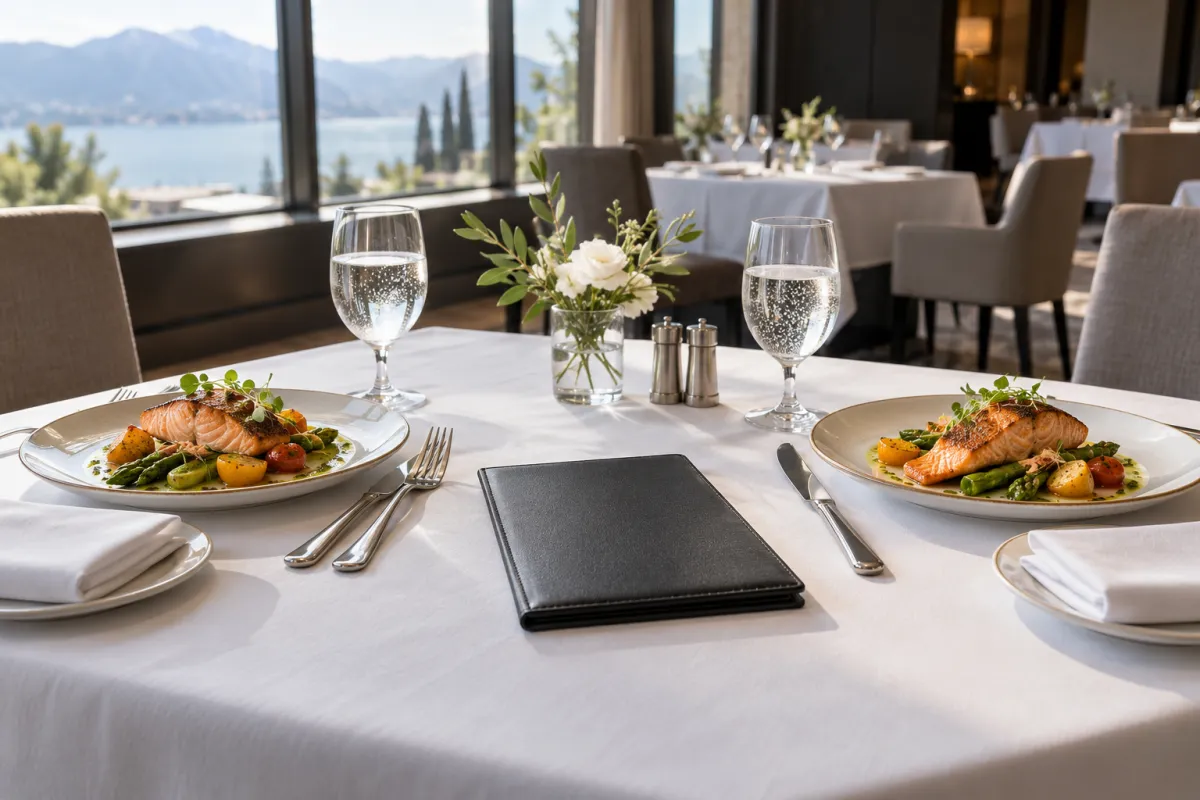
A recruiter emails to say the hiring manager would like to continue the conversation over lunch near the office on Thursday. Before you think about what to wear, you are probably wondering who pays for a job interview lunch, and whether reaching for your wallet makes you look gracious or inexperienced.
The answer is reassuring. In the US and Canada, an interview meal is a business meal hosted by the company, and the company covers it, tip included. Your job at that table is to be a good guest and a strong candidate, not to manage the check. The nuance is in the edge cases: informational interviews you requested, coffee chats with recruiters, travel days with reimbursement, and the rare interviewer who seems to forget the bill exists.
Below you’ll find the verdict, a situation table, what to say when the check lands, how to order, and how the same host logic carries over to other tricky tables, such as dinner with a friend’s partner or a holiday meal at a restaurant.
Short answer: The employer pays. When a company or interviewer invites you to a lunch interview, they are the host and cover the meal and the tip, usually on a corporate card, and you should not offer to split or pay. The one big exception is an informational interview you asked for: then you are the host and should offer to pay.
The verdict: who pays for a job interview lunch
If the company invited you, the company pays. Career advisers are unusually unanimous on this point. University of Richmond Career Services puts it plainly: “The interviewer will typically handle the bill using a corporate card or expense account. They will also take care of the gratuity” (University of Richmond Career Services).
It helps to think of the lunch as a conference room with better food. The company booked the room, set the agenda and chose the time. You would never offer to pay for the conference room, and the restaurant bill works the same way. The meal is a business expense for the employer and part of the hiring process, not a social favor you need to return.
That gives you a simple default:
- Company or interviewer invited you: they pay for everything, including tip.
- You invited them (for advice or networking): you are the host and should offer to pay.
- Unclear who invited whom: the person who proposed the meal and picked the place usually hosts; when in doubt, let the more senior professional lead.
Same principle, social version: most awkward bill moments happen because nobody said who pays upfront. MeetNow, a free app for meeting people in person, builds that into every plan: the host states host pays, split equally, pay your own or free before anyone asks to join.
Who pays by interview situation
Not every meal around a job search is a formal interview. Use this table to match your situation to the usual norm in the US and Canada.
| Situation | Usual norm | Exceptions |
|---|---|---|
| Formal lunch interview arranged by the company | Employer or interviewer pays for the meal and the tip | Practically none; if the bill lands in front of you, see the scripts below |
| Panel or team lunch with several interviewers | The most senior person or the designated organizer pays and expenses it | How the team handles it internally is not your concern |
| Coffee chat set up by a recruiter who contacted you | Recruiter pays | At a counter-service café, let them order first and accept their offer |
| Informational interview you requested | You are the host and offer to pay | A senior contact may insist on paying; accept graciously |
| Networking lunch a mutual friend suggested | Whoever asked for the meeting offers to pay | If it is genuinely mutual, a light “shall we split it?” is fine |
| Travel interview day with meals on your own | Follow the company’s travel instructions; often you pay and submit receipts | Ask the recruiter before the trip if the policy is unclear |
| Late-stage dinner where your partner is invited | Company pays for both of you | None; the invitation sets the terms |
| Lunch with a colleague about an internal role | The person who invited pays, or each pays their own | Internal team norms vary, so take your cue from the inviter |
Why the employer pays: the host rule
The interview lunch is a clean example of the oldest rule in dining etiquette. As the Emily Post Institute summarizes it, “Standard etiquette dictates that whoever initiates or extends the invitation for a meal is responsible for the bill” (The Emily Post Institute). We unpack where that principle holds and where it bends in our guide to when whoever invites pays.
In a job interview, several things reinforce that rule:
- The company set the terms. It chose the format, the restaurant and the time. That is hosting by definition.
- It is a business expense. The interviewer is almost always using a corporate card or expense account, so paying costs them nothing personally.
- The power dynamic is uneven. You are being evaluated. Asking a candidate to fund part of their own evaluation would be odd, and good employers know it.
- Clarity protects everyone. A clean “we’ve got this” keeps the focus on the conversation rather than on the receipt.
The same logic shows up across professional dining. If you later find yourself hosting clients or taking your own team out, our breakdown of who pays for a business dinner covers client, boss and team scenarios.

What to do when the check arrives
This is the moment many candidates overthink. The instinct to offer is polite in social life, but at an interview it backfires. University of Richmond Career Services is direct: “You should never offer to pay for your meal, split the check, or cover the tip. Doing so can create an awkward dynamic and goes against standard corporate interview etiquette” (University of Richmond Career Services).
Here is the sequence that works:
- Let the check sit. Do not reach for it, glance at it or comment on it. Keep the conversation going.
- If the server places it near you, leave it where it is or move it gently toward the center of the table. The interviewer will pick it up.
- Do not offer the tip. The host handles gratuity as part of the bill.
- Thank them warmly once. A single sincere thank-you is better than repeated apologies about the cost.
- Follow up in writing. Mention the lunch in your thank-you email after the interview.
A simple line at the end of the meal is all you need: “Thank you so much for lunch. I really enjoyed hearing about the team’s plans for next year.” It thanks them for the meal and steers back to the job in one breath.
The exception: informational interviews and networking coffees
The rule flips when you are the one asking for time. According to University of Richmond Career Services, “If you reached out to someone to request an informational interview or a networking chat to ask for their advice, you are considered the host and should offer to pay for their coffee or meal” (University of Richmond Career Services).
That makes sense: they are doing you a favor by sharing their experience, and buying the coffee is a small way to acknowledge it. A few practical tips:
- Suggest a simple format. Coffee or a quick lunch near their office respects their time and keeps the bill modest.
- Pay at the counter if you can. At a café, step up first and say, “What can I get you? This one’s on me.”
- At a sit-down restaurant, ask the server quietly for the check or hand over your card early, so there is no tug-of-war.
- If they insist, let them. Senior professionals often enjoy treating someone early in their career. Refusing repeatedly turns kindness into friction.
For more phrasing options, see our scripts for offering to pay politely, which cover the moment when someone tries to pay instead.
If the person is someone you only know online, treat it like any first meeting: pick a public café or restaurant, tell a friend where you’ll be, arrange your own way there and home, and feel free to leave if anything feels off.
How to order when the company is paying
A free lunch is still part of the interview. The guidance from career offices is consistent: “Even though the company is paying, standard interview etiquette suggests ordering something moderately priced (avoid the most expensive items on the menu), easy to eat neatly… and avoiding alcohol unless the interviewer orders a drink first and insists it is fine” (University of Richmond Career Services).
In practice, that means:
- Aim for the middle of the menu. Not the cheapest item, which can look like you are uncomfortable, and not the priciest, which can look like you are taking advantage.
- Ask for a recommendation. “What do you usually get here?” is a natural opener and often reveals the expected price range.
- Choose easy-to-eat food. Skip dishes that need two hands, drip or splatter, so you can talk and listen without worrying about your shirt.
- Let the interviewer lead on extras. Appetizers, dessert and coffee are their call. If they order dessert, a coffee or a small plate keeps pace without overdoing it.
- Hold off on alcohol. Only consider a drink if the interviewer orders first and clearly says it is fine, and even then, one is the ceiling.
- Skip the to-go box. Leaving with leftovers can read as casual in a setting that is still formal.
Awkward scenarios and how to handle them
The interviewer seems to forget the bill
Give it time. Interviewers often pay discreetly, sometimes by handing a card to the server on the way back from the restroom. If the meal is clearly over and the check has been sitting for a while, you can gently signal readiness to leave without mentioning money: “This has been great. I don’t want to keep you from your afternoon.” That usually prompts them to settle up.
The server hands the check to you
Servers sometimes guess. Simply place it in the center of the table or toward your interviewer with a smile. No comment is needed.
The interviewer suggests splitting
This is rare and somewhat unusual for a formal interview. If it happens, pay your share calmly and without visible surprise: “Of course, no problem.” Do not argue the point. Quietly note it as one small data point about the company’s culture and expense policies, alongside everything else you learn.
You are traveling and told meals are reimbursed
When a company flies you in, meals outside the interview itself may be on you first, with reimbursement afterward. Read the travel email carefully, keep itemized receipts, stay within whatever guidelines they give, and ask the recruiter before the trip if anything is unclear. Asking is professional, not pushy.
A recruiter invites you for coffee
If an agency or in-house recruiter reached out to you, they are the host. At a counter-service café, let them order and pay. If they ask what you’d like, a regular coffee or tea is perfect.
Same logic, other tables: a friend’s partner and holiday dinners
The host rule that settles who pays for a job interview lunch also untangles plenty of social meals. Two that come up often:
Who pays when going out with a friend’s partner
If you are meeting your friend’s new partner for the first time, the default is that each person or couple covers their own share, unless someone clearly invites. If your friend says “we’d love to take you out,” they are hosting. If the partner proposes the meal, they host. When it is just the two of you, perhaps planning a surprise for your friend, whoever suggested the meetup should offer to pay, and splitting is a perfectly fair fallback. If the conversation about the check feels delicate, our guide on how to ask to split the bill has wording that keeps it light.
Who pays for Christmas dinner at a restaurant
For a holiday meal out, the person who organized and invited usually hosts. Many families have their own patterns: parents treating adult children, siblings rotating years, or everyone splitting by household. If no tradition exists, settle it in the invitation rather than at the table: “We’re booking Christmas dinner at the Italian place; we’ll split by household, if that works for everyone.” A company holiday lunch follows the interview rule exactly: the employer invited, so the employer pays. For a wider view across occasions, see our full guide to who pays for dinner in every situation.
Scripts you can copy
| Moment | What to say |
|---|---|
| End of a lunch interview | “Thank you so much for lunch. I really enjoyed learning more about the role.” |
| Server hands you the check | Say nothing; slide it gently to the center of the table. |
| Interviewer forgets the bill | “This has been great. I don’t want to keep you from your afternoon.” |
| Inviting someone to an informational interview | “Would you be open to a 30-minute coffee? I’d love to buy you one and hear about your path.” |
| Paying at an informational coffee | “This one’s on me. Thanks for making the time.” |
| Senior contact insists on paying | “That’s very generous, thank you. I’ll pass it forward.” |
| Thank-you email after the interview | “Thank you again for lunch on Thursday and for walking me through the team’s priorities.” |
| Clarifying a travel meal policy | “Before my trip, could you confirm how meals outside the interview are handled?” |
Want to turn this into an actual plan? MeetNow is a free app for meeting people in person: a host posts a plan at a public place, says who pays (host pays, split, pay your own or free) and picks who joins. It is live on the web and works in your browser, starting in Malta. The Android app is on Google Play; the iPhone app is not in the App Store yet. Open MeetNow and see the plans posted in Malta.
FAQ: job interview lunch etiquette
Should I offer to pay for a job interview lunch?
No. When the company or interviewer invited you, they are the host and pay the bill, usually on a corporate card or expense account. Offering to pay or split can create an awkward moment and goes against standard interview etiquette. A sincere thank-you is the right response.
Do I need to leave the tip at an interview lunch?
No. The interviewer handles the gratuity along with the bill. Offering to cover the tip is just as awkward as offering to pay for your meal, so leave it to your host.
Who pays for an informational interview coffee?
You do, or at least you offer. If you asked someone for their time and advice, you are the host and should offer to pay for their coffee or meal. If a senior contact insists on paying, accept graciously and thank them.
Can I order alcohol at a lunch interview?
It is best to skip it. Only consider a drink if the interviewer orders one first and clearly says it is fine, and keep it to one. Sparkling water or iced tea is always a safe choice.
What if the interviewer asks me to split the bill?
It is rare, but if it happens, pay your share calmly and without fuss. Do not argue or show surprise. You can quietly treat it as one small piece of information about the company’s culture.
Should I thank the interviewer for lunch?
Yes. Thank them once at the table when the meal ends and mention the lunch again in your follow-up thank-you email. Pairing the thanks with something specific from the conversation keeps the focus on the role.