A game night is one of the few social plans where the most expensive item can be a bag of tortilla chips. That is exactly why the money part is worth getting right. If you are working out how to host game night on a budget, the games are rarely the problem. The friction comes from who buys the snacks, whether guests should chip in, and how to say that in the invite without sounding stingy.
This guide starts with a clear default, then walks through 15 worked examples. Each one has an estimated cost per person and a who-pays suggestion you can copy into a group chat. All costs are rough planning estimates in US dollars for a typical US or Canadian city, not quoted prices. Grocery and café prices vary a lot by city and store, so treat the ranges as a starting point and convert to CAD if you are in Canada.
One more thing before the list: a game night doesn’t have to happen at night. Many of the ideas below work just as well as a Saturday afternoon or a Sunday brunch, which is often cheaper and easier for people with kids, early shifts or a long trip home.
How to Host Game Night on a Budget: Who Pays for What
The verdict: whoever sends the invite covers the basics. That means the space, the games, something to drink (water, coffee, tea or one big pitcher) and a clean table. Anything beyond that is fair to share, as long as you say so up front.
This follows a long-standing etiquette idea: the person who extends the invitation should be prepared to pay for it, a principle the Hindustan Times etiquette guide, drawing on Emily Post, applies to dates. At home, that translates into hosting the essentials, not catering a feast. Asking guests to bring a snack is completely normal in the US and Canada; asking them for money after the fact, without warning, is what feels off.
Most budget game nights fall into one of three formats. Pick one and name it in the invite:
| Format | Who pays | Best for |
|---|---|---|
| Host treats | Host covers drinks and snacks | Small groups, celebrating someone, paying back a favor |
| Potluck / bring your own | Each guest brings one item; host covers basics | Regular game nights, mixed budgets, groups of six or more |
| Split the groceries | Host shops, everyone splits the total evenly | Pizza or meal nights where one shared order makes sense |
If you host often, rotate. A group where one person always provides everything slowly turns generosity into an expectation. Our guide on what to do when a friend always expects you to pay covers how to change that pattern kindly.
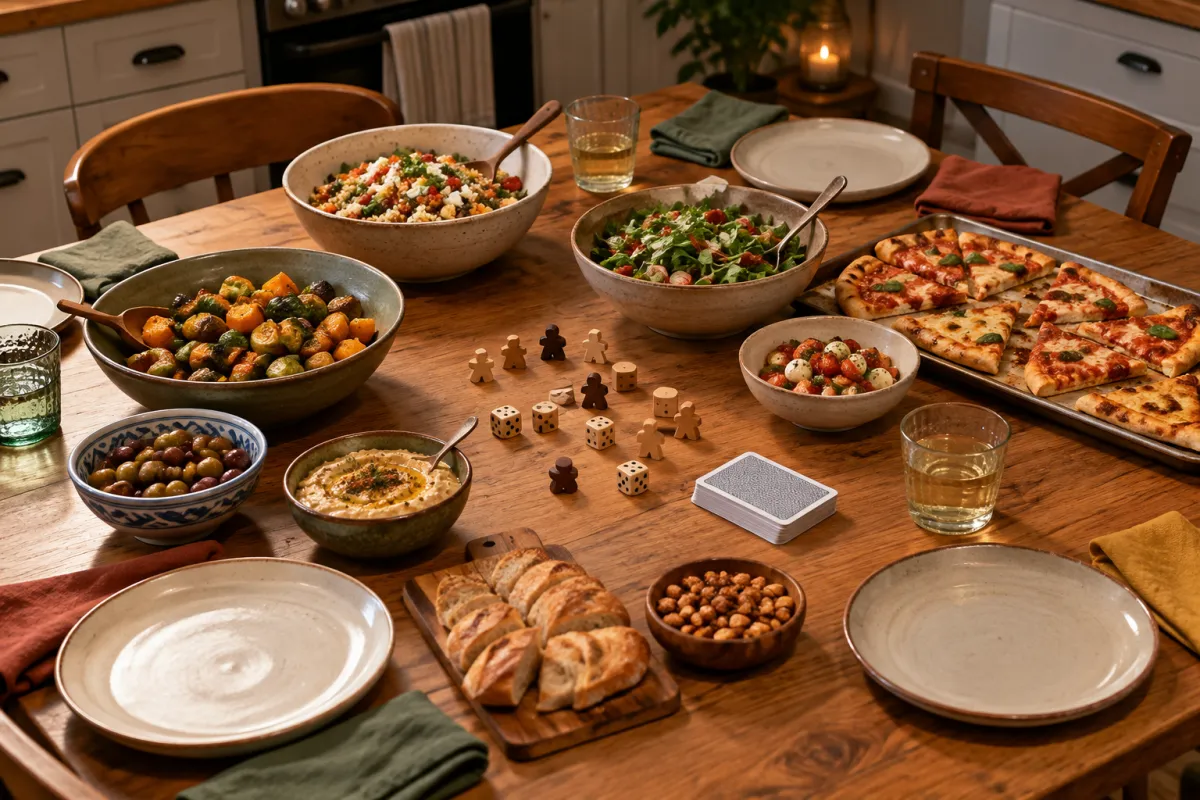
What a Budget Game Night Costs: A Worked Example
Here is an illustrative example, not a statistic. Say six people are coming, and the host already owns a couple of games and a deck of cards. The shopping list might be two bags of chips, a jar of salsa, popcorn kernels to pop at home, two large bottles of soda or sparkling water and a bag of ice. In many US and Canadian grocery stores, a list like that might land somewhere around $25 to $35 total, depending on brands and city. Split six ways, that is roughly $4 to $6 each; or the host simply absorbs it as their treat.
Compare that with taking the same group out. A restaurant adds tax and a tip on top of every plate, and tipping is still firmly expected at sit-down places: about 70% of restaurant-goers say they always tip their server at a sit-down venue, while roughly 63% of Americans hold at least one negative view of modern tipping culture, according to Bankrate’s tipping research. A game night at home skips that whole conversation.
Ways to keep the total down without anyone noticing:
- Make one big thing instead of five small ones. A large bowl of homemade popcorn or one tray of nachos feeds more people per dollar than a spread of packaged snacks.
- Buy store brands for chips, soda and crackers; nobody checks the label mid-game.
- Use real dishes if you have them, so you are not buying disposable plates and cups.
- Skip buying new games. Borrow, swap or play classics that need only cards, paper or dice.
- Track shared costs in an app if your group splits regularly; our comparison of free bill-splitting apps shows the options.
15 Budget Game Night Ideas With Cost per Person and Who Pays
Each idea below includes an estimated cost per person in USD and a who-pays suggestion. These are planning ranges based on typical grocery runs, not prices from any specific store; your city may be higher or lower. For plans that get people out of the house instead, see our list of cheap group activities for adults.
| Idea | Est. cost per person (USD) | Who pays |
|---|---|---|
| Cards-and-classics night | $0 to $3 | Host |
| Potluck game night | $5 to $10 | Each guest brings a dish |
| Homemade trivia | $0 to $3 | Host |
| Paper-and-pen party games | $0 | Nobody |
| Poker for chips, not cash | $3 to $6 | Split snacks |
| Make-your-own pizza | $4 to $8 | Split evenly |
| Game swap night | $0 to $5 | Bring your own snack |
| Library-loan game night | $0 | Host |
| Mystery dinner party | $5 to $10 | Potluck |
| Console tournament | $0 to $5 | Bring your own drinks |
| Lawn games in the park | $0 to $5 | Pay your own |
| Board game café | Café’s posted fee plus a drink | Pay your own |
| Birthday game night for a friend | $5 to $12 | Guests, including honoree’s share |
| Your own birthday game night | $0 to $5 for guests | You cover essentials |
| Dessert-and-dice night | $2 to $5 | Host |
1. Cards-and-classics night
One deck of cards covers spades, hearts, rummy, euchre, crazy eights and dozens more. Add any games already on your shelf and you have a full evening or afternoon for almost nothing. Put out a bowl of something salty and a pitcher of iced tea.
Cost per person: about $0 to $3. Who pays: the host, with no ask needed. This is the easiest format to host on short notice.
2. Potluck game night
Everyone brings one dish or drink, and the host handles plates, ice and the table. Assign loose categories in the invite (salty, sweet, drinks, something with vegetables) so you don’t end up with six bags of chips.
Cost per person: about $5 to $10 for one dish. Who pays: each guest covers their own contribution; the host covers the basics.
3. Homemade trivia
The host writes four or five short rounds: general knowledge, music, a picture round printed or drawn by hand, and a round about the group itself. Teams of two or three keep it social. The prize can be bragging rights or a homemade trophy.
Cost per person: about $0 to $3. Who pays: the host, since the effort is the gift.
4. Paper-and-pen party games
Charades, a drawing-and-guessing game, and Fishbowl (also called Celebrity) need nothing but scrap paper, pens and a bowl. They work for large groups and mixed ages.
Cost per person: $0. Who pays: nobody; the host supplies paper.
5. Poker for chips, not cash
Play for poker chips, pennies or candy so nobody loses money and nobody feels pressured. Say clearly in the invite that there are no real stakes. Snacks are the only real cost.
Cost per person: about $3 to $6 for shared snacks. Who pays: split the snack run evenly, or rotate hosting so each person covers snacks once.
6. Make-your-own pizza and party games
Store-bought or homemade dough, one jar of sauce, cheese and a few toppings let everyone build a small pizza between rounds. It feels like a meal without the delivery fees.
Cost per person: about $4 to $8. Who pays: the host shops and everyone splits evenly. Put the estimated amount in the invite so it is not a surprise.
7. Game swap night
Each guest brings one game they own and teaches it. You get variety without buying anything, and people discover new favorites they can borrow afterward.
Cost per person: about $0 to $5. Who pays: bring your own snack or drink; the host covers water and ice.
8. Library-loan game night
Some public libraries lend board games or keep a game collection on site. Check your local branch’s catalog before planning around it, and return games on time.
Cost per person: $0. Who pays: the host, who handles the borrowing and any late fee if it happens.
9. Mystery dinner party
The host writes simple character cards or uses a free printable, and guests come in loose costume. Make the food a themed potluck so the host is not stuck buying a full dinner.
Cost per person: about $5 to $10. Who pays: potluck for food; the host covers the script and decorations.
10. Console tournament
If someone owns a gaming console and a few controllers, draw a bracket on paper and play short rounds. People waiting their turn can play cards on the side.
Cost per person: about $0 to $5. Who pays: bring your own drinks; the console owner hosts.
11. Lawn games in the park
Frisbee, bocce, a cornhole set if someone owns one, or cards on a blanket. A daytime park session is free, works for bigger groups and is a comfortable first meetup for newer friends. Check your park’s rules before bringing anything big.
Cost per person: about $0 to $5. Who pays: pay your own snacks, or everyone brings one thing to share.
12. Board game café
Many board game cafés charge a per-person play fee on top of food and drinks; check the café’s posted fee before you invite people. Ask for separate checks when you order. If you end up with one check, split it so each person’s tip matches what they ordered: Split The Cost notes that tips should match the proportion of what each person ordered, exactly like the subtotal and tax.
Cost per person: the café’s posted fee plus whatever each person orders. Who pays: pay your own, unless the organizer clearly said they are treating.
13. Birthday game night for a friend
When friends organize a celebration for someone else, the honoree doesn’t pay. The Emily Post Institute advises that the cost of the honoree’s meal and drinks is split evenly among the rest of the group, alongside everyone paying for their own. At a home game night, that means guests split the groceries, cake and decorations, and the birthday person contributes nothing. More low-cost party formats are in our guide to cheap ways to celebrate a birthday.
Cost per person: about $5 to $12, including a share of the honoree’s portion. Who pays: the guests, split evenly.
14. Your own birthday game night
The same Emily Post guidance points the other way when you organize your own celebration: because you initiated it, you cover your own share and any extras, and guests aren’t expected to subsidize you. At home, host the essentials and the cake yourself. Guests may bring a drink or snack, but don’t charge them for your party.
Cost per person: about $0 to $5 for guests who bring something. Who pays: you cover the essentials.
15. Dessert-and-dice night
Bake one tray of brownies or cookies, make a pot of coffee or tea, and play a dice game or a quick card game. It is a low-key, low-cost way to say thanks to a friend who helped you move or covered your last dinner.
Cost per person: about $2 to $5. Who pays: the host treats. This is the simplest version of an “I’ve got this” evening.

Budget Brunch Ideas for a Daytime Game Session
A game brunch is often cheaper than an evening spread, because breakfast staples like eggs, flour, oats and fruit go a long way. It also suits groups with early bedtimes or long drives home. These budget brunch ideas pair well with lighter games like cards, word games or a quick trivia round:
- Pancake or waffle bar: one big batch of batter plus a few toppings. Estimated $3 to $6 per person.
- Egg bake or frittata: eggs, a few vegetables and cheese in one dish that feeds a crowd. Estimated $3 to $6 per person.
- Breakfast tacos: scrambled eggs, tortillas, salsa and potatoes. Estimated $4 to $7 per person.
- Yogurt and granola bar: no cooking, easy to scale. Estimated $3 to $5 per person.
- Bring-your-own bubbles: host provides orange juice; guests bring sparkling wine or sparkling water if they want it.
Who pays: the host makes the main dish; guests bring fruit, juice or pastries. If you are making something more ambitious, it is fine to say “brunch is about $5 each” in the invite. Restaurant brunch for a group usually means waiting for a table, a tip on every plate and the end-of-meal check shuffle; brunch at home keeps all of that off the table.
How to Treat Your Parents to Dinner With a Game Night at Home
If you have been wondering how to treat your parents to dinner without a big restaurant bill, a home dinner followed by the card or board game your family always played can mean more than a fancy reservation. Cook one dish you do well, set the table properly, and pull out the dominoes, rummy or whatever was the household favorite.
The verdict: when the evening is your treat, you pay for everything and you don’t ask them to bring anything. Parents often try anyway. Let them bring a small item like dessert if it clearly matters to them, but turn down money or offers to split the groceries.
A script for when they push: “This one’s on me. You fed me for eighteen years; I can handle one dinner.” If they insist on paying you back, suggest they host the next game night instead of reaching for their wallet.
If you would rather take them out, decide the plan in advance, tell the server quietly that the check comes to you, and handle it before anyone reaches for a card. For the trickier version of this, when a partner’s parents are involved, see our guide on who pays for dinner when meeting the parents.
Copy-and-Paste Scripts for the Invite
Clear money language in the invite is the single biggest factor in how to host game night on a budget without awkwardness. Say the format once, plainly, and nobody has to guess. Pick the line that fits your plan:
- Host treats: “Game night at my place on Saturday! I’ve got snacks and drinks covered, just bring yourselves.”
- Potluck: “Game night Saturday at 4. I’ll have drinks and games; could everyone bring one snack to share? Drop what you’re bringing in the chat so we don’t double up.”
- Split groceries: “Pizza and games on Friday. I’ll do the shopping, it’ll be around $6 each, and I’ll send a request after.”
- Friend’s birthday: “Let’s do a game night for Sam’s birthday! Let’s cover Sam’s share between us; it should work out to a few extra dollars each.”
- Board game café: “Board game café on Sunday afternoon. Heads up that they charge a play fee per person, and we’ll each pay our own.”
If someone forgets to pay their share, one friendly reminder with the exact amount is fair; after that, let it go or adjust who you split with next time. Our guide on how to ask to split the bill has more scripts for the follow-up.
Playing With People You Don’t Know Well Yet
Game nights are a great way to turn acquaintances into friends, but your home is not the place for a first meetup with someone you only know from an app or a single conversation. Start in public instead:
- Meet somewhere public, such as a park, a library game area or a board game café.
- Tell a friend where you are going and roughly when you expect to be done.
- Have your own way home, so you are never dependent on someone you just met for a ride.
- Leave if you are uncomfortable. “I’m going to head out, thanks for the game” is a complete sentence.
For public meetups, “pay your own” is the cleanest default. Once you have played together a few times, moving the game night to someone’s home is a natural next step.
Want to turn this into an actual plan? MeetNow is a free app for meeting people in person: a host posts a plan at a public place, says who pays (host pays, split, pay your own or free) and picks who joins. It is live on the web and works in your browser, starting in Malta. The Android app is on Google Play; the iPhone app is not in the App Store yet. Open MeetNow and see the plans posted in Malta.
Frequently Asked Questions
Should the host pay for everything at a game night?
No. The host is expected to cover the basics: the space, the games and something to drink. Snacks and meals can be shared through a potluck or an even split, as long as the host says so in the invite. The host covers everything only when they have clearly offered to treat.
Is it rude to ask guests to bring snacks or chip in?
Not at all, as long as you ask in the invite rather than after the fact. Asking each guest to bring one snack or drink is normal in the US and Canada. Asking for money is fine too if you give an estimated amount up front, such as about $6 each for pizza.
How much should a budget game night cost per person?
Most home game nights land somewhere around $0 to $15 per person as a rough estimate, depending on whether you serve snacks or a meal and on grocery prices in your city. Card games, paper games and borrowed games cost almost nothing; pizza or brunch nights sit at the higher end.
Who pays at a game night for someone’s birthday?
If friends organize it for someone else, the birthday person does not pay and the group splits the honoree’s share along with the groceries, following Emily Post’s guidance on group birthday dinners. If you host your own birthday game night, you cover the essentials and the cake, and guests are not expected to subsidize you.
How do you split shared grocery costs fairly?
Keep the receipt, divide the total evenly among everyone who ate, and send the exact amount in one message or through a bill-splitting app. Even splits work best for shared food. If you go out to a café and get one check, split each person’s subtotal, tax and tip in proportion to what they ordered.