The short answer
Tipping in Germany is customary but modest: about 5–10% at restaurants and cafés with table service, or simply rounding up on small bills. The big difference from the US is how you do it. You don’t leave money on the table; you tell the server the total you want to pay when they come to collect. Hand over €50 on a €45 bill and say “Stimmt so” (“keep the change”), or say “20 Euro, bitte” on an €18.50 bill when paying by card. Service is usually not included in the price. Last checked October 2026.
Below: how much to tip by setting, exactly what to say at the table, card payments, worked examples in euros with a US-dollar guide, and the mistakes visitors make most.
Do you tip in Germany?
Yes, most people do. Tipping (Trinkgeld, literally “drink money”) is a normal part of eating out in Germany, but the amounts are smaller than in the US, and staff are paid a wage that does not depend on tips.
A 2026 tipping study by the travel company TUI, which surveyed 2,000 Germans about their tipping habits on holiday (The Local notes that Germans tend to tip about as much on vacation as they do at home) and was reported by The Local Germany in September 2026, found that:
- just over half of Germans typically leave 5–10% in restaurants, cafés, taxis and many other service settings,
- 21.2% tip 10% or more,
- and only 3.3% leave no tip at all.
So while a tip is not legally required, leaving nothing after table service is unusual in Germany. Rounding up is the minimum most people do.
If you are traveling on to southern Europe, our guide to tipping in Greece covers tavernas, cafés and taxis there.
How to tip in Germany: say the total out loud
This is the part that surprises visitors. In Germany the server usually comes to your table with a wallet or a card terminal and you pay right there. The tip is added during that moment, by telling them what to charge or what to keep:
- Ask for the bill: “Die Rechnung, bitte” or simply “Zahlen, bitte” (“We’d like to pay”).
- The server tells you the amount, for example “45 Euro.”
- Paying cash: hand over a note and say the total you want to pay, or “Stimmt so” if the note already covers the bill plus your tip.
- Paying by card: before they key in the amount, say the total: “Machen Sie 50, bitte” (“Make it 50, please”).
- Say thank you: “Danke, schönen Abend noch!”
The Local describes exactly this: Germans usually add the tip while paying and round up, for example handing over €50 on a €45 bill and saying “Stimmt so,” or telling the server “20 Euro, bitte” on an €18.50 card payment. All About Berlin’s guide to tipping in Germany gives the same advice for card payments: say the total before the payment is processed.
Phrases you will use
| English | German | When |
|---|---|---|
| The bill, please / We’d like to pay | Die Rechnung, bitte / Zahlen, bitte | When you are ready |
| Keep the change | Stimmt so | Your cash already includes the tip |
| Make it 50, please | Machen Sie 50, bitte / 50, bitte | Cash or card, to set the total |
| Is service included? | Ist der Service inklusive? | If you are unsure |
| Together or separately? | Zusammen oder getrennt? | The server will ask groups this |
| Can I pay by card? | Kann ich mit Karte zahlen? | Before ordering at small places |

How much to tip in Germany: amounts by setting
Common practice, not rules. Euro amounts with a rough US-dollar guide at about $1.15 per euro; check your bank’s current rate. Last checked October 2026.
| Where | Customary tip | Notes |
|---|---|---|
| Restaurant with table service | About 5–10% | Round to a clean number; 10% for very good service |
| Café with table service | Round up, or about 5–10% | On a coffee and cake, rounding up is usual |
| Bar with table service | Round up | A bit more for a long evening with one server |
| Counter or self-service (bakery, Imbiss, beer garden self-service) | Nothing expected | A tip jar is optional |
| Taxi | Round up, or about 5–10% | Say the total when paying |
| Hotel porter | €1–2 per bag (about $1.15–2.30) | Optional |
| Hotel housekeeping | A few euros for the stay | Leave it clearly marked |
| Hairdresser | Commonly tipped | Round up or about 5–10% |
| Food delivery | Round up or a euro or two | Optional |
Going far above 10% is not expected. A generous 15% is fine, but locals rarely go higher.
Is service included in Germany?
Usually not. German menu prices include VAT but generally not a service charge, which is why tipping is customary. Some upscale restaurants do add one, shown on the menu or bill as Bedienung inklusive (service included). If you see it, any extra tip is optional. If you are not sure, ask: “Ist der Service inklusive?”
Card payments and tipping
Card acceptance in Germany has grown a lot, but it is still worth asking at small cafés, bakeries and old-style pubs whether cards are taken before you order. When you do pay by card:
- Say the total before the server types it in. “Machen Sie 30, bitte.” Once the payment has gone through, adding a tip is awkward.
- Or pay by card and tip in cash. Hand the coins to the server directly rather than leaving them on the table.
- Some terminals show tip options. They are optional; choosing a percentage or “no tip” is up to you.
- Charge in euros. If the terminal offers to charge you in dollars, choosing euros generally avoids an extra conversion markup.
Worked examples
Illustrative prices, not quotes from a real restaurant. Dollar figures rounded at about $1.15 per euro.
| Situation | Bill | What you say | You pay | Tip |
|---|---|---|---|---|
| Coffee and cake for one | €8.40 | “Neun Euro, bitte” (“nine euros”) | €9 (about $10) | €0.60 (round up) |
| Lunch for two | €18.50 | “20 Euro, bitte” | €20 (about $23) | €1.50 (about 8%) |
| Dinner for two, cash | €45.00 | Hand over €50: “Stimmt so” | €50 (about $58) | €5 (about 11%) |
| Dinner for four, card | €126.00 | “Machen Sie 138, bitte” | €138 (about $159) | €12 (about 9.5%) |
| Taxi from the station | €16.80 | “18, bitte” | €18 (about $21) | €1.20 (about 7%) |
Groups: tipping when you pay separately
German servers often ask groups “Zusammen oder getrennt?” (“Together or separately?”). Paying separately is very common, and the server will go around the table and tell each person what they owe. In that case, each person adds their own tip by saying their own total. If you pay together, one person adds a tip for the whole table and the others settle up with them. For fair ways to divide a shared bill, see how to split the bill fairly.

Seasonal situations: beer festivals and Christmas markets
Two very German settings come up often for visitors, and both follow the same logic as everywhere else: table service gets a tip, counter service does not.
- Christmas markets. You order mulled wine (Glühwein) or food at a stall counter, so no tip is expected. Drinks are often served in a mug with a deposit (Pfand) added to the price; you get it back when you return the mug, or you keep the mug as a souvenir. The deposit is not a tip.
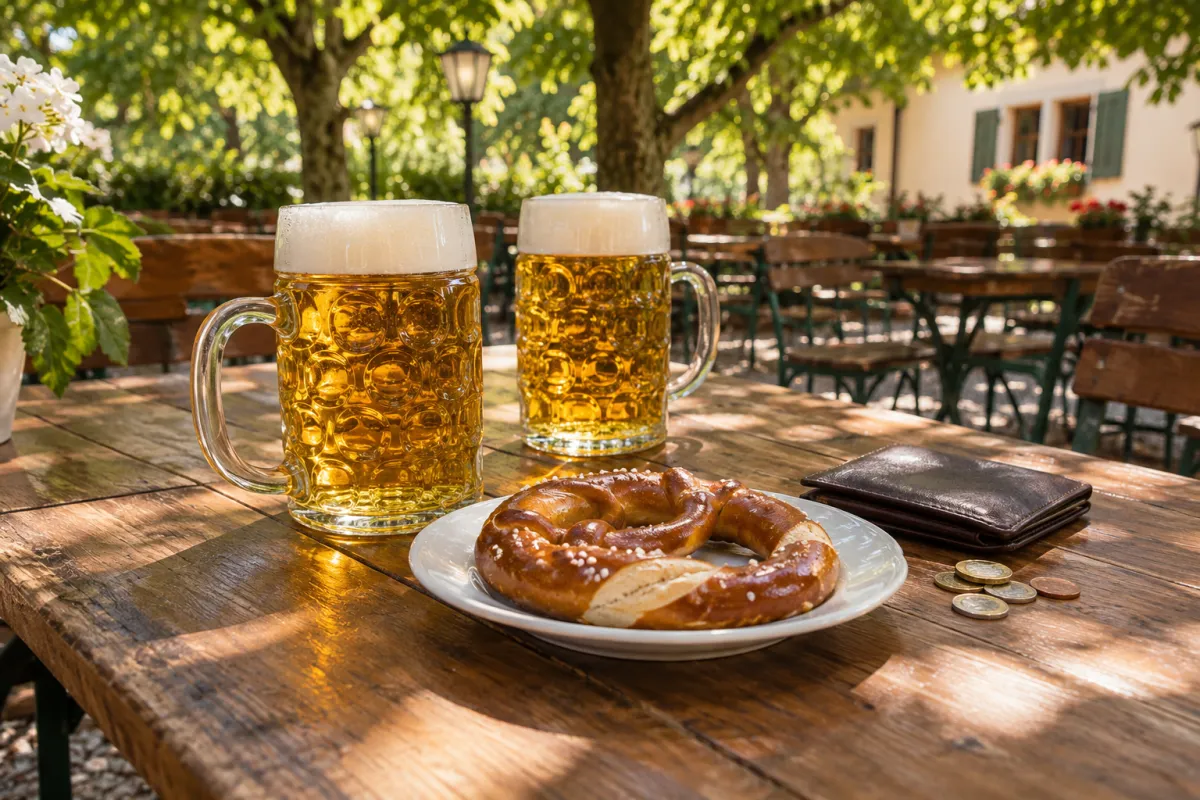
- Beer tents and beer halls with table service. When a server brings drinks and food to your table, round up or add about 5–10% as you would in a restaurant, by telling them the total when you pay.
- Beer garden self-service. Many traditional beer gardens have self-service counters where you collect your own beer and food. No tip is expected there, although a coin in a tip jar is always welcome.
- Bakeries and snack stands. Pay at the counter; nothing more is needed.
How tipping in Germany differs from the US
For American and Canadian visitors, three habits need resetting:
- The percentage. Think 5–10%, not 15–20%. Rounding a €27.30 lunch to €30 is a perfectly good tip.
- The moment. The tip is spoken, not written. There is usually no tip line to fill in on a receipt after you sign.
- The check. The bill rarely comes unprompted. Ask for it; nobody is trying to hurry you out.
Germany vs France and the US
| Germany | France | US and Canada | |
|---|---|---|---|
| Restaurant tip | About 5–10% | Optional extra; €1–2 per person | 15–20% |
| Service in the price? | Usually not | Yes (service compris) | No |
| How you tip | Say the total when paying | Coins on the table, or ask before a card payment | Card slip or terminal |
| Separate payments | Very common (“getrennt”) | Possible; mention it early | Common; ask for separate checks |
For the French system, see our guide to tipping in France. For the phrases to ask for the bill or to pay separately in other countries, see our guide to asking for the bill in different languages.
Common mistakes visitors make
- Leaving money on the table. It is not the custom; the server expects to settle with you directly.
- Saying “danke” when handing over cash. Many servers take “danke” as “keep the change.” Only say it if that is what you mean; otherwise state the total.
- Tipping US-style 20%. It is well above what is expected.
- Forgetting to say the total on a card payment. Say it before the server keys in the amount.
- Assuming cards are accepted everywhere. Ask first at small places.
- Tipping at self-service counters. Not expected.
Planning a meal with people you just met?
German tables make one thing easy: everyone is used to asking “together or separately?” Saying how the bill works before you sit down does the same for any group.
Want to turn this into an actual plan? MeetNow is a free app for meeting people in person: a host posts a plan at a public place, says who pays (host pays, split, pay your own or free) and picks who joins. It is live on the web now, starting in Malta, with the phone apps on the way: open MeetNow and see the plans near you.
FAQ: tipping in Germany
How much do you tip in Germany?
About 5–10% at restaurants and cafés with table service is the usual range, and rounding up is common on small bills. A 2026 TUI survey of Germans’ holiday tipping habits, reported by The Local, found that just over half typically leave 5–10%.
What does stimmt so mean?
“Stimmt so” means “that’s fine” or “keep the change.” You say it when you hand over cash that includes your tip, so the server knows not to give you change.
Do you leave the tip on the table in Germany?
Usually not. Germans add the tip while paying by telling the server the total they want to pay, for example “20 Euro, bitte” on an €18.50 bill.
Can you tip by card in Germany?
Yes. Tell the server the total including the tip before they process the card payment. Once the payment has gone through, it is hard to add a tip.
Is service included in German restaurants?
Usually not. Some upscale places add a service charge, shown as “Bedienung inklusive.” If you are unsure, ask: “Ist der Service inklusive?”
Do you tip taxi drivers in Germany?
Commonly, yes: round up the fare or add about 5–10%. Say the total you want to pay when you hand over cash or a card.
The bottom line
Tipping in Germany means about 5–10% for table service, rounding up for small bills and nothing at self-service counters. Say the total you want to pay when the server comes to collect, use “Stimmt so” when your cash already covers it, and tell them the total before a card payment. Ask “together or separately?” early in groups, and each person tips on their own share.