The short answer
To split a bill with tax and tip fairly, give each person the same share of tax and tip as their share of the food: divide the final total (subtotal + tax + tip) by the subtotal to get one multiplier, then multiply what each person ordered by it. If the subtotal is $160 and the final total with tax and tip is $204.80, the multiplier is 1.28, so someone who ordered $45 of food pays $57.60. Shared dishes get divided first among the people who ate them. If everyone ordered roughly the same, an even split is simpler and perfectly polite. Last checked November 2026.
How to split a bill with tax and tip: the multiplier method
Tax and tip are both percentages of the food and drink you ordered, so the fairest split is proportional: whoever ordered more pays more tax and more tip. You do not need to calculate tax and tip separately for each person. One number does all the work.
- Find the subtotal on the check: food and drinks before tax.
- Add tax (the receipt shows it) and the tip you agree on, to get the final total.
- Divide the final total by the subtotal. That is your multiplier, usually somewhere around 1.2 to 1.3 in the US.
- Multiply each person’s items by the multiplier. That is what they owe, tax and tip included.
- Check the sum. Everyone’s amounts should add up to the final total, give or take a few cents of rounding.
This works with any tax rate and any tip percentage, which is why it travels well from state to state. For the bigger picture of when to itemize and when not to, see our guide on how to split the bill fairly.
Worked example: four friends, one check
Illustrative numbers. Ana, Ben, Chloe and Dev share one check. Sales tax is 8% and they agree on a 20% tip on the pre-tax subtotal.
| Line | Amount |
|---|---|
| Subtotal (food and drinks) | $160.00 |
| Tax at 8% | $12.80 |
| Tip at 20% of $160 | $32.00 |
| Final total | $204.80 |
| Multiplier ($204.80 ÷ $160) | 1.28 |
| Person | Ordered | Tax share | Tip share | Pays (ordered × 1.28) |
|---|---|---|---|---|
| Ana | $45.00 | $3.60 | $9.00 | $57.60 |
| Ben | $38.00 | $3.04 | $7.60 | $48.64 |
| Chloe | $52.00 | $4.16 | $10.40 | $66.56 |
| Dev | $25.00 | $2.00 | $5.00 | $32.00 |
| Total | $160.00 | $12.80 | $32.00 | $204.80 |
Everything balances. Compare that with an even split of $51.20 each: Dev, who had a salad and water, would pay $19.20 more than his share, and Chloe would pay $15.36 less. That gap is exactly why many groups prefer to itemize when orders vary a lot. For more scenarios, see our worked examples on how to split a restaurant bill.

Adding shared appetizers and bottles
Shared items go into each person’s “ordered” amount before you apply the multiplier. Split each shared item only among the people who had it.
Say Ana, Ben and Chloe shared a $24 appetizer (included in the $160 subtotal above, with the individual mains now $37, $30, $44 and Dev’s $25 untouched):
| Person | Own items | Share of appetizer | Ordered total | Pays (× 1.28) |
|---|---|---|---|---|
| Ana | $37.00 | $8.00 | $45.00 | $57.60 |
| Ben | $30.00 | $8.00 | $38.00 | $48.64 |
| Chloe | $44.00 | $8.00 | $52.00 | $66.56 |
| Dev | $25.00 | $0.00 | $25.00 | $32.00 |
The same logic applies to a bottle of wine: divide it among the people who drank it. Non-drinkers should never have to subsidize the bar tab, and saying so upfront avoids resentment later.
Tip on the pre-tax or post-tax amount?
For sit-down service in the US, a tip of 15–20% is common practice. Traditionally it is calculated on the pre-tax subtotal, because tax is a government charge, not part of the service. Many card terminals and payment screens, however, suggest percentages based on the post-tax total, and plenty of diners simply tip on that. Either is widely accepted.
The difference is small. In our example, 20% of the pre-tax $160 is $32.00; 20% of the post-tax $172.80 is $34.56, a gap of $2.56 across four people. What matters more is that the whole table uses the same base, agreed before anyone pays. If you are tipping on the post-tax amount, the multiplier method still works: just use the new final total ($172.80 + $34.56 = $207.36, multiplier 1.296).
Special cases: auto-gratuity, discounts, Canada
Automatic gratuity for large parties
Many restaurants add an automatic gratuity or service charge for larger groups. Check the receipt before tipping: if a gratuity line is already there, do not add a second full tip unless you want to. Use the receipt’s final total in the multiplier and you are done. Our explainer on service charge vs tip covers which charges are mandatory and who keeps the money.
Coupons, gift cards and discounts
If the table used a discount, many people tip on the pre-discount amount, since the server did the same work. Decide who benefits from the discount: if one person’s coupon reduced the bill, it is fair that their share drops, not everyone’s.
Splitting a bill in Canada
The method is identical; only the tax line changes by province. In Ontario, for example, the HST is 13%. On a CAD 100 subtotal with an 18% tip on the pre-tax amount, the final total is CAD 131, so the multiplier is 1.31. Check the tax line on your receipt for the exact rate where you are, and see our guide to tipping in Canada by province for local norms.
Paying at the table with separate cards
Many restaurants can run several cards for one check, but policies differ, especially for large groups. Ask before ordering; our guide on whether restaurants allow splitting the check covers what to expect.

Even split or itemized: which to choose
| Situation | Best method | Why |
|---|---|---|
| Everyone ordered similar amounts | Even split | Fast, and the differences are a few dollars at most |
| One or two people ordered much less | Itemized with the multiplier | Avoids light eaters subsidizing others |
| Drinkers and non-drinkers | Even split of food, drinks itemized | Alcohol is usually the biggest gap |
| One person paid with a card | Itemized, then reimburse via payment app | Everyone sends their exact amount |
| Recurring dinners with the same friends | Rotate who pays, or track in an app | Evens out over time with less math |
If one person covers the card and everyone pays them back, an expense app saves arguments; our comparison of Splitwise vs Settle Up shows how two popular options handle it, and our roundup of the best bill splitting apps compares more. Round each person’s share up to the nearest dollar and let the extra go to the tip; it keeps transfers clean. Wondering whether sending a payment request feels pushy? See our take on whether it is rude to Venmo request a friend.
Scripts for the table
Before ordering
“Quick one before we order: separate checks, or one check and we each pay for what we had plus tax and tip?”
When one check arrives
“The total with tax and a 20% tip comes to 1.28 times the food, so just multiply what you ordered by 1.28. I’ll post the numbers in the chat.”
When an even split would be unfair
“Would anyone mind if we itemize? A few of us ordered a lot less this time.” Our guide on how to ask to split the bill has more wording for awkward moments.
Who pays, decided in advance
The easiest split is the one everyone agreed to before the menus came out. If you are the one organizing a group dinner, put the payment rule in the invitation itself, for example “pay your own, mains are around $25 before tax and tip”, so guests know the deal before they say yes and nobody needs a calculator at the end.
Want to turn this into an actual plan? MeetNow is a free app for meeting people in person: a host posts a plan at a public place, says who pays (host pays, split, pay your own or free) and picks who joins. It is live on the web and works in your browser, starting in Malta: open MeetNow and see the plans near you.
Frequently asked questions (FAQ)
How do you split a bill with tax and tip?
Divide the final total (subtotal plus tax plus tip) by the subtotal to get a multiplier, then multiply what each person ordered by that number. Each person automatically pays their proportional share of tax and tip.
Should tip be calculated before or after tax?
Traditionally the tip is based on the pre-tax subtotal, but many payment screens use the post-tax total and both are widely accepted. The difference is usually a couple of dollars; just make sure the whole table uses the same base.
How do you split shared appetizers?
Divide each shared item among only the people who ate it, add that share to each person’s own items, then apply the multiplier to get what they owe with tax and tip.
Is it rude to ask to split the bill by what each person ordered?
No. It is common and fair, especially when orders differ a lot. Suggest it before ordering if you can, and keep the tone light.
What if the restaurant already added a gratuity?
Check the receipt for an automatic gratuity or service charge. If one is included, you do not need to add another full tip. Use the receipt’s final total to calculate the multiplier.
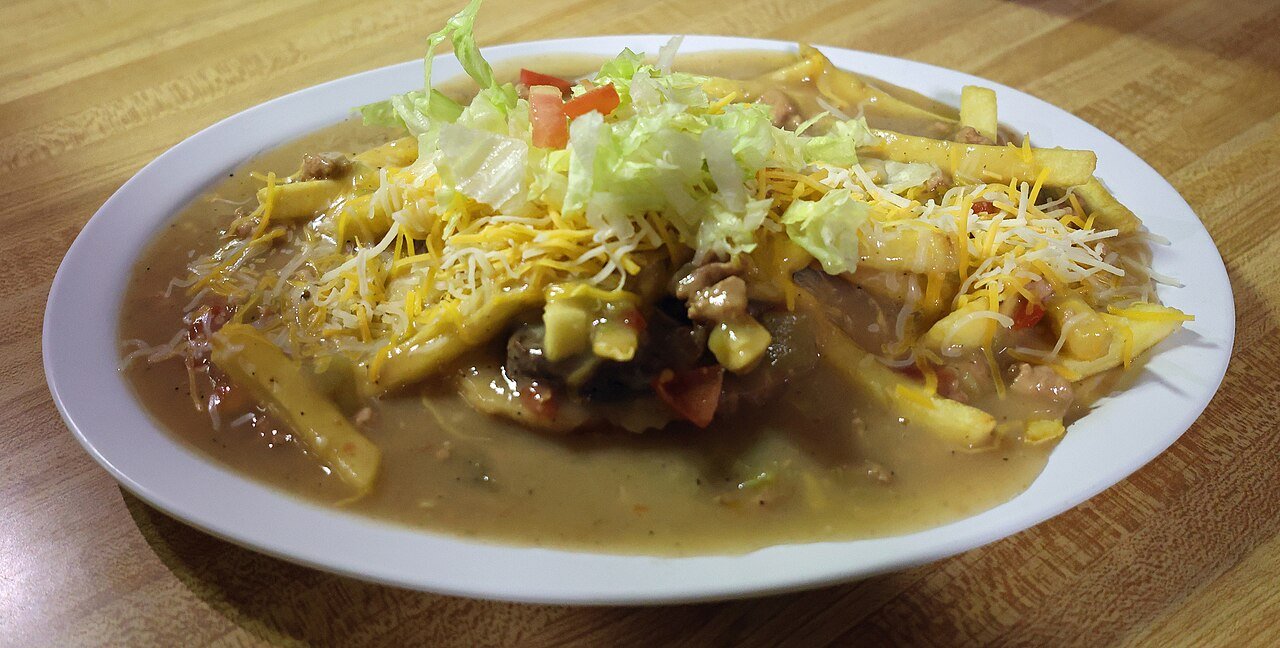
Featured photo: a diner plate of burger and fries smothered in green chile, TC’s Diner, Walsenburg, Colorado, by Jeffrey Beall, CC BY 4.0, via Wikimedia Commons.